
Jonathan Moffat sits down with Chip Fichtner, founder of Large Practice Sales, to unpack what every dentist needs to know about invisible DSOs. Chip explains how these partnerships differ from traditional DSOs, why more doctors in their 30s are pursuing them, and how the right deal can help you monetize your practice today while still growing bigger, faster, and smarter with a partner. From valuations to recapitalizations to red flags to avoid, this is a crash course in one of the most important trends shaping dentistry.
Find Jonathan at jonathanmoffat.com
Learn more about Aligned Advisors at alignedadvisors.com
Find Jonathan on LinkedIn: linkedin.com/in/jonathanmoffat1
Find Austin on LinkedIn: linkedin.com/in/austinmoffat
Learn more at largepracticesales.com
—
Watch the episode here
Listen to the podcast here
What Really Happens When You Sell To An IDSO With Chip Fichtner
With me is a special guest, Founder and CEO of Large Practice Sales, Chip Fichtner. Chip is the Founder of Large Practice Sales, where he and his team have completed over $1 billion in Invisible DSO, IDSO partnerships in the last 36 months. I look forward to getting into what an Invisible DSO is with you here in a few minutes, Chip. With decades of experience building, buying, and selling companies across multiple industries, Chip has become a trusted voice for dentists navigating the rapidly evolving DSO, IDSO landscape.
His work has been featured in national media and his firm represents practices in structuring some of the largest and most strategic partnerships in dentistry. Chip, thanks for being on here. As we were saying before, I really enjoyed our time in Nashville and getting to learn more about you and your company and very impressive what you guys have done and continue to do in the industry.
Thanks for having me, Jonathan. I appreciate it.
What Is An Invisible DSO
We were at dinner for a couple of hours, I talked to you the next day for another. I was just very impressed with everything that you said, and all the work you’re doing with dentists and especially in our industry. I guess let’s start with a question, I’m going to guess a lot of our readers would have, which is what’s an Invisible DSO?
An Invisible DSO is an interesting animal because most doctors don’t fully understand it. An Invisible DSO functionally becomes a doctor’s silent partner by buying anywhere between 51% and 80% of a doctor’s practice. The doctor retains ownership and continues to lead the practice with his or her brand, team, strategy, and most importantly, when you choose the right Invisible DSO silent partner, full autonomy. Meaning, these groups have no desire to homogenize or marginalize the doctors or their practices, instead they look for practices where the Invisible DSOs’ support infrastructure can help the practice grow bigger, better, more profitable, and faster.

The Invisible DSOs are not a new concept. They’ve been around for 35 years, there are over 1,000 of them in the US today. We consider less than 100 of those qualified to bid on our clients for a variety of reasons, but when you choose the right Invisible DSO partner, your practicing life doesn’t change except you’re going to have some administrative support, you’re going to have recruiting support, you’re going to have marketing support, and you’re going to be paying 30% less for supplies than independent dentists are. What’s changed in the last couple of years is you’re also going to be getting reimbursed at higher rates from insurance payers than independent dentists do.
An Invisible DSO becomes a silent support partner and it also enables you to monetize a part of your life’s work for cash at today’s low long-term capital gains tax rates. Therefore, you can diversify your personal portfolio, reduce your personal risk. However, the Invisible DSOs are different from the traditional DSOs who want to buy 100% of your practice and typically near the end of your career and you’ll work for a couple of years for them as an employee and then you will transition or retire.
The Invisible DSOs on the other hand are eager for younger doctors. Of those billion dollars of partnerships we’ve created in the last 36 months or less, $150 million of that were for doctors in their 30s. These were doctors that were interested in accessing the capital and resources of an Invisible DSO partner to help them grow their business, whether it’s expanding their existing practice, acquiring competitors, or building de novo offices. The Invisible DSOs can provide the resources and capital to make that possible. The traditional branded DSOs don’t operate that way.
Thank you for that. I think if we were. You did a great job of explaining that. As most people think of a DSO, they probably think of corporate. They’re going to come in they’re going to buy 100% of my practice. I may have to change my name to their name. I may have to or not. Basically, they’re going to run the ship. I’m now an employee. I’m going as a W-2 employee under that.
You typically would still see a structure of a certain percentage of cash and a certain percentage of equity even though they’ve purchased 100% versus the Invisible DSO, which is more of a partnership where they’re going to buy, I think you said was 50% to 80% of the practice and then you’re going to retain that ownership. How does that structure, again, from a standpoint of you maintain control, you get administrative support, it sounds like that’s what a lot of doctors want in a partnership anyways. Is one more tax beneficial than the other from an income tax standpoint, I would imagine?
No. When you’re selling an asset that you’ve had or stock that you’ve had for more than a year it’s going to get taxed at long-term capital gains tax rates. From a DSO or an Invisible DSO standpoint, the tax will be the same. The Invisible DSOs’ opportunity for doctors is that they get to continue to run their practice successfully as they have in the past, but again, access the resources of a much larger partner. Some Invisible DSOs nowadays have 800 partner practices across the country and others may only have a couple of dozen.
The tax will be the same from a DSO or an Invisible DSO standpoint. But with an IDSO, doctors have the opportunity to continue running their practice successfully as they have in the past. Share on XIf you choose the right Invisible DSO partner, the real upside in that partnership besides reduced administrative burdens because they’re going to take over banking, accounting, payroll, benefits, benefits administration, compliance, credentialing, tax, legal, IT support, and vendor and payer negotiations.
After that, the doctor gets to continue to run the practice as they have done in the past successfully. They have no desire to change or homogenize a practice. It’s a different model that works because the doctor still has skin in the game. The doctor’s going to retain ownership either directly at the practice level, at the parent company level, or a combination of both. Our clients typically will have all three structure options to choose from, and of course, they’re going to get paid for doing dentistry every day. It’s a very attractive structure once you understand it and if you choose the right partner. There are plenty of partners out there that are the wrong choice.
What would be your process or what advice would you give to doctors who are going down this path of, “How do I choose the right partner?”
What we sell in essence is a conversation with me. I love to talk to doctors because I learn something from everyone that I talk to. Basically, the first step in the process is schedule a call with me, let’s have a conversation, learn a little bit about your practice and then we can give you an idea whether you’re going to qualify for an Invisible DSO partnership because not all practices will. Typically, a specialty practice is going to need to have at least $1.5 million in collections and a GP practice is going to need to have at least $1.8 million in collections.
It’s those practices that will qualify for a high value Invisible DSO partnership. The values in an Invisible DSO partnership are much higher than a 100% sale to a DSO or a sale to another doctor. Significant difference and part of that is because the doctor’s going to commit to continue to lead the practice for years or decades into the future.
There’s the old adage, “If you’ve seen one DSO, you’ve seen one DSO.” I know everyone’s got their different minutia of this, but in an Invisible DSO, I would think one advantage, going back to the tax piece because I know for us, for our clients who’ve transitioned or sold to DSOs, I would say the biggest lifestyle adjustment that they’ve had to make is going from a, “I own my business, I run all my expenses through my practice. I pay myself a salary, but I also take distributions and run all these expenses through there so I get this tax benefit,” to, “Now I’m a W-2 employee, I don’t have any of those benefits.” That’s one of the biggest shocks.
If you structure it correctly, it doesn’t have to be that way.
Okay, so that was my question. I would imagine with the Invisible DSO, at least what we talk to a lot of our clients about is you can keep that professional corporation, that doctor PC there, and still continue to pay yourself through that PC and still get some of those benefits that you would have otherwise. Would you typically or generally agree that’s how you would structure those?
Yes. It depends on what you want, but absolutely because in 99% of the transactions we do, it’s an asset sale. Your existing entity, whether it’s a PC or a PLLC or sub-S or whatever it is, you’re still going to retain ownership of that entity. The transaction with the Invisible DSO will involve you selling the practice assets that are currently held in that entity typically to a new entity that’s formed by the Invisible DSO that functionally becomes your practice. You’re keeping the entity in which you’re currently executing your tax optimization strategies, and that doesn’t have to change.
I know you and I, we have these conversations, we use these terms every day but for some people reading, some of this may be new to them. Chip, you said asset sale, the alternative, the other type of sale would be a stock sale where you’re actually selling stock in your entity. I would imagine, again, you see way more deals than I do but we typically generally discourage stock sales to clients and also, we don’t really see that many stock sales happening. I’m sure there are cases or reasons for that to happen, but to your point, most of them are going to be an asset, an asset sale, right?
Yeah, about 99%.
Knowing The Right Time To Get Into Invisible DSOs
Going back to our dinner because I just got so much out of that dinner, you just mentioned here $150 million of your $1 billion in transactions over the last 36 months or less were doctors in their 30s. I think most people think of like “When I’m going to sell my practice is when I’m ready to retire.” I know even at our dinner, I was like, “What about this?” You’re like, “Too old.” There are these parameters that I think maybe 5, 6, 7 years ago may not have been as stringent.
I’m sure part of that was because these DSOs or IDSOs, Invisible DSOs, maybe were still learning as they were going. Now, again, we’re hearing it more and more, the money’s gotten smarter, private equity’s gotten smarter, DSOs have gotten smarter, they’ve learned, some a lot of them have been burned.
I think it’s safe to say they have more of a clear picture of this is the ideal partner for us in these IDSOs, Invisible DSO structures. If you were talking to a doctor, when would you say is “When you get to this point or when your practice gets to this point, this is the optimal time to start looking at or having this conversation of whether this is a good option to go.”
I urge every doctor to have a conversation with me no matter where they are in the cycle of their practice, whether they’re 30 or whether they’re 60. Let’s have a conversation and talk about the options because it changes. It changes regularly. For instance, a few years ago, and I’m 65 so I can pick on old guys, if you were a 65-year-old doctor with a great practice in the right geography, we could do a deal for you. Today if you’re a single 65-year-old doctor, unless you’re an oral surgeon, it’s going to be very difficult to achieve any kind of high value in an Invisible DSO partnership.
What I tell doctors is let’s have a conversation, at least understand the concept and if you like, we’ll go through your numbers and give you an idea of what your value is now and you may say “I’m going to keep doing this for another 2 years and call me in 2 years and we’ll update the numbers and give you an idea what your progress has been.”
Doctors with the longest horizon will achieve the highest values. Share on XWe’ve got clients that we’ve signed in the last month that I’ve been talking to for five years because sometimes the time’s right and sometimes the time is not. Once doctors understand these partnerships and the benefits they can bring and the upside possibilities of the growth in the value of that retained ownership piece that they keep, many doctors become eager.
It’s a great opportunity to learn because all the Invisible DSOs are different. Some of them are eager for single specialty, some are eager for multispecialty. Right now, there’s a big opportunity for perio, endo, oral surgeons because some of the larger Invisible DSOs that have been GP focused may now have 10, 20, 30 practices in a community. They’re eager to partner with specialists so that those gps have a place to refer to that’s within the family. You can create lots of organic growth for a specialty practice when you have 10, 20, or 30 GP practices that are eager and dedicated to referring to you.
From a GP perspective, the changes in technology nowadays, all of the major Invisible DSOs and DSOs have implemented AI in their diagnostic procedures and in other places. The independent dentist now from our survey, it’s probably less than 25%. AI in diagnostics really is an important thing to have and the Invisible DSOs have done the testing, done the research and picked the brand that they’re going to support and use across their network. Keep in mind, they’re never going to force their partner practices to use that particular AI or any AI for that matter. It’s completely up to the doctor as to how they want to practice and the technologies they want to use.
From a timing perspective, it’s a function of what the doctor’s goals are. Now, if you are 55-plus, you need a plan because an Invisible DSO partnership will be your highest potential exit value and many of the Invisible DSOs will want you to continue as an owner leading your practice for at least five years. Certainly, we’ve done transactions for doctors who have stayed for shorter periods of time, but the highest values are achieved by the doctors who say, “I love doing dentistry. If somebody will take the administrative headaches off my back, I would love to do this until I can’t.”
The doctors with the longest horizon as to their desire to practice achieve the highest values. Now that doesn’t mean that a doctor with a short horizon is not going to achieve a high value, but the doctors with the longest horizons will achieve the highest values. It pays to understand it now. Whether you’re 30 or 50, you should at least understand the Invisible DSO option. As I like to say “If you’re big enough, you’ll either join one or compete with many in the coming years,” because they are everywhere and they’re growing rapidly. Part of the growth is driven by the money.
In 2024, there was over $8 billion of new financing and capital invested in the Invisible DSOs. There was obviously other capital and financing provided to the traditional DSOs as well, but the Invisible DSOs got the majority of that capital. If you look at BlackRock, which is the world’s largest asset manager with over $13 trillion under management, they have invested in 4 Invisible DSOs just in the last 30 months.
It’s not just private equity, it’s traditional investors, it’s family offices, it’s even sovereign wealth funds are backing Invisible DSOs. The country of Abu Dhabi, which has a population of less than 1 million people, has the third largest sovereign wealth fund in the world after China and Norway. They’ve invested over $1 billion in US Invisible DSOs with lots of oil money. The bottom line is it’s all about education. It’s about understanding them and you’ll know when the time is right. The time when it’s right for you will be dictated by the potential value of your practice, what your growth plans are and ultimately what your exit plan is.
Determining The Real Value Of Your Practice
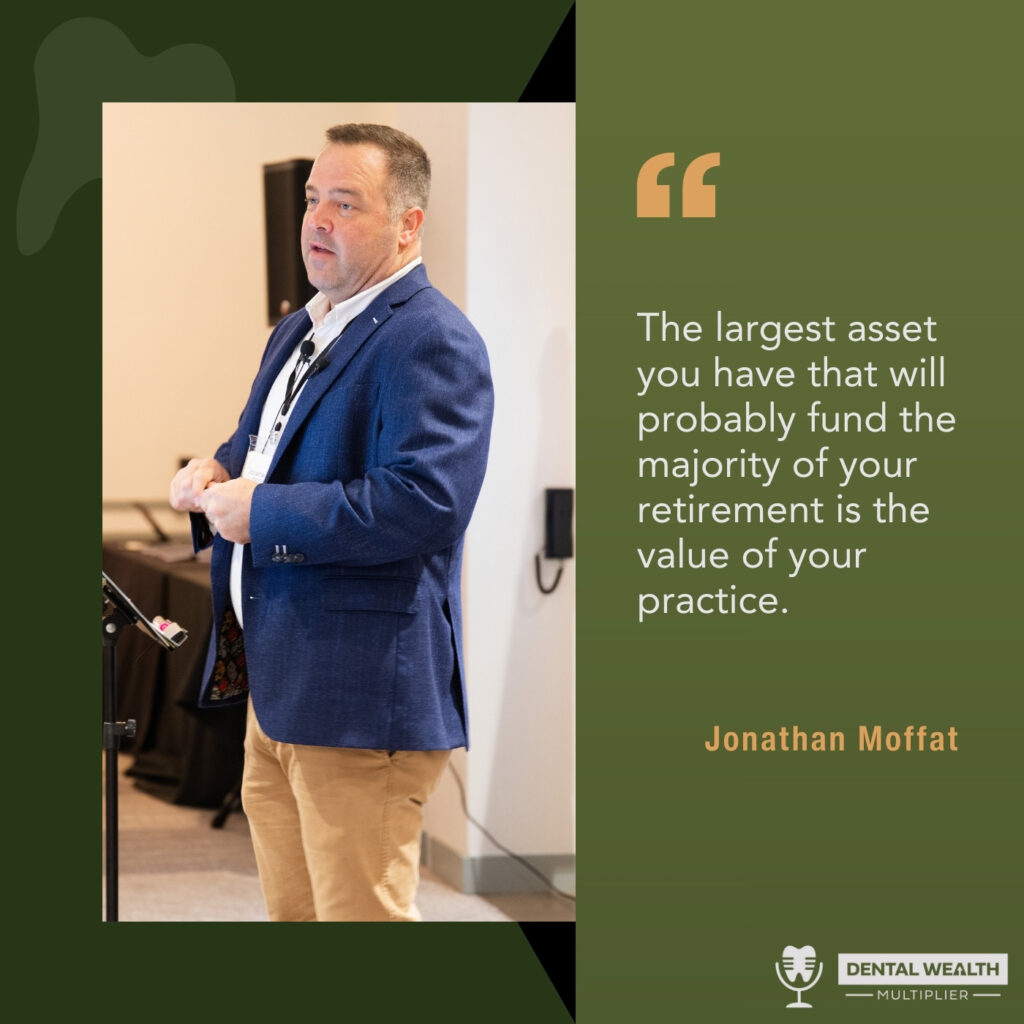
I say all the time when I’m speaking, I’ll say “How many of you could tell me within a close proximity of what your home is worth?” Every hand goes up. We all know approximately what our house is worth. Right. Great. “How many of you could tell me what your practice is worth?” No hand goes up. Maybe one guy, “I could tell you,” because he’s going to guess. It’s like “How many of you are going to sell your home to retire?” No one’s going to sell their home. “How many of you are going to sell your practice to retire?” Every hand goes up. The largest asset that you have that’s going to be probably going to fund the majority of your retirement, you don’t know what the value is.
All of our clients, we want them to update their values every single year. We want an updated value of what their practice. Especially, again, because it’s going to be it’s the largest asset that’s going to fund that future. I always talk to clients. I’m like, “It never hurts to have a conversation.” we’ve referred several over to you like, “Find out what it’s worth. If it’s not worth what you think it is, ask the question ‘what do I need to do to make it more valuable? What do I need to do to be more attractive or to bring more money?'” that’s another great conversation to have. Who wouldn’t want to know how to add more value to their business even if you have no interest in selling. It’s like you get a second look at what you have and what the value is of what you have.
It’s very true. When a doctor goes through our valuation process, it’s confidential, it’s not that hard and it’s free. Why not? We look at well over 1,000 sets of practice financials from across the country every year and so we have a pretty good idea of what a well-run practice looks like and what a not so well-run practice looks like. We’re just planting a seed and it’s always nice to have a baseline. We have many prospects that we talk to annually and we update their numbers and give them an idea of what their progress has been. We’ll update the value potential for the practice.
The big challenge for practices I see coming in the next 6 to 12 to longer is the challenge of declining collections. Nowadays, the Invisible DSOs, because so many doctors are interested in this concept now far more than there were a few years ago, now have plenty of supply of doctors interested in becoming their partners and so they’ve become far more selective in the practices that they partner with. They have more inventory to choose from effectively. Now, the big risk to a doctor of not doing a partnership is if their practice collections decline, then they run the risk that they become unsellable at all.
Certainly, in my world, you could still do a low value doctor to doctor deal. However, if we have a recession or an economic event of some sort and practice collections decline, they functionally will have to wait 6 to 12 months minimum to return to growth and then be eligible for an Invisible DSO partnership sometime in the future. Functionally, every doctor who’s interested in the Invisible DSO concept should understand it now, understand their potential value because a year from now, it may not be possible at all.
Why do you say that?
Well, because if you have a declining practice, I can’t get you any value. I won’t take you as a client, and the reason I wouldn’t take you as a client is no Invisible DSOs are going to partner with a practice with declining collections. Keep in mind, the collections do decline. If we go back and look at the period of 2005 to 2010, the financial performance of the average dental practice in the US declined by 2% each year compounded for five years. Now, there were plenty of exceptions to that and there were plenty of growing practices during the ’08, ‘09 fiasco, but on average, they declined.
In today’s world, unless you have a growing practice, you’re not going to do a deal with an Invisible DSO and you certainly aren’t going to do one at a high value. I’m not an optimist on our future economy at the moment, given tariffs and inflation and everything else. Doctors should at least understand their value now while they are growing and then they can make a decision as to whether they’re susceptible to not growing.
We can look at ortho for instance and go back to 2022, an average ortho practice saw case starts decline by 8% that year, 6% in ‘23 and another 5% in ‘24. Those ortho practices that experienced that decline now are unsellable at any value. The corollary to that is interesting and that if you have a growing ortho practice it’s much more valuable now than it was two years ago but you have to be growing.
The Current Climate And Environment Of Invisible DSOs
You’re different. You figured out something that the rest of the industry didn’t figure out. You’ve got systems and processes in place. This is an interesting conversation and about just the current environment. I was telling you I was recently at a Dykema’s event in Colorado and literally, I was telling everyone there were two hot topics.
Everybody was talking about 2 things and 2 things only and they came up in every conversation. Number one was AI, which you’ve already mentioned, the importance of AI and adopting that and incorporating into your practice and technology. You’re going to have to do that to stay and be competitive, I believe.
The second one was the current state of the market. Interest of private equity, valuations going down, groups appears to be struggling to recap maybe as easily or as regularly or frequently as they had in the past. I know we’ve certainly seen that with our clients who’ve sold to some large IDSOs and DSOs this delayed recap. What are you seeing? What’s your take on where we are with the current environment in this space?
It’s interesting in that what’s happened is that given the amount of capital that has come into the Invisible DSOs, if we go back a few years ago, the Invisible DSOs were less selective on the practices that they partner with than they are now. Nowadays, if you have a quality practice within a quality Invisible DSO, recapitalizations are still happening. The largest recapitalization in the history of dental happened in November of 2024 at a value of $3.8 billion. Fortunately, we had 50-plus clients who had joined that group over the last seven years. Some joining them back when their initial value was only $300 million.
They got to experience twelve times return on that equity piece that they kept as a part of a transaction. There will be another Invisible DSO recapitalization announced here in the next week or two, a large one. There are several in process that will be successful. What’s changed is that the investors who are those who put up the money for the recap have like the Invisible DSOs become far more selective in what they will invest in. The management of that group that runs the $3.8 billion recapitalized Invisible DSO and I are pretty close and I followed their process as they interviewed the various investors throughout 2024.
The key thing that the investors were looking for were the Invisible DSOs were they providing services and support to their partner practices that enabled those partner practices to grow their EBITDA, to grow their bottom line. The Invisible DSOs that will continue to recapitalize and continue to do so at high values are those which are providing the services and support to grow their partner practice.
The groups that went out there and just acquired revenue and didn’t really provide services or did not integrate their partner practices from an operational standpoint, those groups may never recapitalize because they’re not providing growth at the practice level and that’s the key metric now for achieving a recapitalization of any value.
The number of recapitalizations has reduced but it’s not gone. There will be more money in recapitalizations invested in next 12 months than were in the last probably 24 months combined because there are a number of well-run groups that are preparing for their recapitalizations. The metric is, did they provide value to their partner practices? If you go back several years ago, it was, “How many new partner practices did you get?” That’s no longer the metric. The metric is now, “What have you done for the practices you partnered with?”
Even a few years ago, that’s when we sold our group to a DSO and it’s interesting because what we saw was even the groups that were that traditional DSO, we’re going to buy 100% of your practice. We’re that model. Even those groups have shifted their model going “I think there’s a better model here which is allowing the doctors to keep some of that ownership,” having them be participating more as a partner as opposed to just selling 100% and then working back for a period of time.
It seems like there was a more of a frequently disengagement from the doctor. “I sold my practice. I just have this stock that isn’t real and may or may not turn into anything” versus “No, you’re still an owner. You maintained your professional corporation, you’re still an owner.” I think there’s more of that sense of that partnership and I think those groups I think one of the reasons we’re seeing that IDSO model take more get more traction is because it feels more like a partnership. It is more like a partnership as opposed to we’re just going to buy you out and hope you stick around for the next couple of years.
It’s pretty simple to understand because when you have a doctor that has ownership, he’s got skin in the game and he or she is going to make doctor-owner-like decisions. Whereas if you sell 100%, you’re an employee. You probably need to be micromanaged or homogenized to fit a corporate standard. If you’ve still got skin in the game, you’re going to make owner-like decisions which benefits everybody, the doctor and the Invisible DSO.
You can look at the number of what I call the traditional branded DSOs that are being created now and it’s very few. Everybody is following the Invisible DSO doctor retains ownership model because it’s proven to work. It’s been around 35 years and the Invisible DSOs have outperformed the traditional DSOs.
There Is Always A Bitter For A Great Practice
I’m going to ask you to get your crystal ball out. I agree with you. I think what’s going to end up happening is a lot of these IDSOs, because again, it’s like any other market. When you have more sellers than there are buyers, the values are going to come down. You’re going to have less groups, less funding. They’re going to be it turns to a buyers’ market. They’re going to be able to have the benefit and the value of having a marketplace where they can be more selective with these groups that they’re investing in.
If you are an IDSO or you’re thinking about starting an IDSO with the hopes or the goal of maybe you’re an emerging DSO. You’ve got 5 or 6 practices and you’re like “I’m going to sell here in the next 1 to 2 years,” what would you be telling someone in that position based on what you’re seeing in the marketplace?
It’s interesting in that we have achieved so far record values for pretty much all practice types. GP, perio, endo, oral surgery, orthodontic and pedo is especially hot because there’s plenty of capital, they’re just being more selective. If you have a great practice, you’re going to have plenty of bidders. We completed a transaction in the Mid-Atlantic, the doctor, a relatively young doctor, growing and we had him eleven times EBITDA. That doesn’t happen that often, but he had a great practice. He was young doctor and one of the things that I remind doctors is that your EBITDA and your financials are merely the ticket into the stadium.
Where the real value comes is for a doctor who can demonstrate that they have a personality, a plan and a passion for dentistry. That plan for growth really adds value. If you have a doctor who can articulate what their goal is and how they plan to grow by utilizing the Invisible DSO’s resources, that’s where you hit values out of the park. There’s no shortage of bidders for quality assets. There’s definitely a shortage of bidders for marginal assets. Geographically, certainly Florida, Tennessee, Texas, Arizona, Colorado have been the hot markets over the last couple of years.

However, what we’re seeing is more and more Invisible DSOs looking at states not in the hot states as we call them, because there’s so much competition for the great practices from multiple Invisible DSOs. We’ve had clients in Florida that had eighteen qualified bidders to choose from. If you’re a client in Florida, you’ve got a good shot at usually having ten qualified bidders to choose from.
Tennessee’s the same thing, Texas a little less. One of our best transactions was we got 11.25 times EBITDA for a practice in Vermont. Why Vermont? Vermont’s got a shrinking population, not a growing population like Florida. It was young doctor with a personality, a passion for dentistry and a plan to grow. There’s going to always be a bidder for a great practice. That’s the key. You’ve got to have a great practice and there are ways to create great practices if you know what you’re looking for.
We’ve been talking about the doctors that maybe want to exit and you know maybe that time horizon’s 5 to 10 years out and they’re like “This is a great exit plan for me,” but if you are a doctor who’s like “I have 2 or 3 practices and I am in my 30s, I’ve got a great plan. I’ve got you know really good systems for growing and maintaining that growth and creating culture,” all those things that we know are important within a successful business. Are IDSOs a good place to look at as a growth partner that can help fund that growth and partner with those future opportunities or future locations that they would want to grow?
Yeah, I think that’s why the majority of our 30-year-old something clients have chosen Invisible DSO partnership because the basic math is interesting. I can monetize 51% of the value of what I’ve built so far, I can get cash, I can secure my future, I can diversify my portfolio, and cash in troubled times is a very valuable resource. I’m going to keep 49% ownership in my practice and with my partner, I’m going to expand my practice, I’m going to acquire competitors, I’m going to build denovos and any of the great Invisible DSOs are eager to support that growth.
The concept to the doctor is, “I can own 49% of something much bigger that I take zero risk to create because I’m using my partner’s risk and capital and I can grow bigger, better, faster. My 49% of something bigger is going to be worth a lot more than me trying to do it by myself and kissing a lot of bank notes and keeping 100%.” The concept of having a silent partner to help young doctors build the empire they dream of makes a whole lot of sense financially because you get to go build it, own 49% of it and take no risk.
From what you’ve seen, there’s a number of you know a number of IDSOs that are making those doing those types of partnerships with these younger doctors.
Yeah, and there’s a reason for that. Come recapitalization time, the metric that they measure is organic growth within existing partner practices, both top line and bottom line. When they partner with a doctor who builds a new office or acquires a competitor, that counts as organic growth for the Invisible DSO. The most valuable doctors are the doctors who can say “I have a plan to grow my business, not just my existing office but perhaps other offices.” that doctor becomes very valuable because it drives up the organic growth rate of the Invisible DSO and that’s the most valuable thing when it comes to exiting from a recapitalization standpoint.
Those doctors with a growth plan can build an empire, take no risk and have significant upside. There are plenty of Invisible DSOs that are eager to finance growth. Now they’re going to do it for doctors who have proven that they can grow. I was on the phone with a doctor who’s 40 years old, he’s built a $6 million in collections practice from scratch. He’s at a point where he says “This is a lot to manage. If I could have a partner that could help me manage some of the administrative minutia and let me focus on continuing to build, I could build a lot bigger.”
Invisible DSOs allow young doctors to have a silent partner who can help build the empire they dream of. Share on XThat doctor will be very valuable in our process, he will have probably a dozen bidders just because he has a track record of having built something from scratch to something fairly big and his plan is he has a plan to grow. He knows what he wants to do and where he wants to go and how he wants to get there. That doctor will have plenty of eager bidders that are happy to put millions of dollars of capital behind him to go execute his growth plan because it’s not like he’s thinking about a growth plan. He’s built a $6 million practice. He’s proven he can do it.
Structuring A Transaction With A Known Exit
Massive. We’ve talked a lot about that. Chip, let me ask you this. I know one of the biggest concerns and hesitancies for a lot of doctors going into this path, going down this road is “Yeah, I get I’m going to get X number of dollars in cash up front but where the big money’s made is on the recap. The growth of the equity.” Is there anything these doctors can do or you advise them to do as far as anything they can do to hedge some of that risk or make sure that if this recap doesn’t happen or we just said here, there’s going to be a lot of these IDSOs that want to recap and aren’t going to be able to just from the sheer fact that there’s so many of them that are in this position.
It’s not the number of them, it’s the number of them that are underperforming. Keep in mind, we’ve structured 150 transactions where the doctor’s exit and upside was not predicated on the completion of a recap. You can structure these transactions such that you say, “I’m going to do this for the next 5 years and when I’m done at the end of 5 years, I want you to buy that remaining equity that I kept as a part of a transaction.” you pre-negotiate a formula as to what that purchase price will be that will typically be based on the EBITDA of the doctor’s practice in that last year, the fifth year of his commitment.
You can structure these transactions that you don’t have to wait for a recap. More and more doctors are interested in that concept because it’s a known exit, it’s not a, “Yeah, they’ve been promising me they’re going to recap for five years and it’s never happened,” you don’t have to wait for that. You can structure a transaction with a known exit.
The Huge Mistake Of Selling To An Associate
Interesting. That’s really insightful. All right. I’m going to play know devil’s advocate, but just give an alternative scenario here. One of the scenarios that we bring up to our clients is yes, you can sell to DSO, IDSO. You can just you can sell the traditional way to another doctor, just single doctor. One of the others that we see gaining a lot of traction, and maybe this is the IDSO model, is you can keep majority of your ownership.
You sell a smaller percentage to an associate so you don’t have to worry about the associate going anywhere and then offload or offset the management of the practice to a management outside management company. Generally, because the doctor keeps the asset and as long as it’s profitable and cashflowing, they’re able to get a lot more money over the 6, 7, 8, 9, 10 years for keeping the asset as opposed to selling it. Obviously, depending on the quality of the management and there’s typically more work that they’re going to have to do because they are a little more involved, but how have you seen or have you seen that model in comparison to selling?
The first flaw in that model honestly is selling a piece to an associate. When a doctor sells a piece to an associate, they’re typically going to value the practice at a traditional doctor to doctor valuation which may come in somewhere between 60% and 100% of collections. Let’s call it 80% of collections for easy math. In my world, we did over $150 million of transactions just in 2024, where the practices were valued at over 300% of collections. By definition, if you go sell a piece to an associate at 80% of collections, you’re leaving millions of dollars on the table.
If you sell a piece of your practice to an associate at 80% of collections, you are leaving millions of dollars on the table. Share on XSelling to an associate happens and it may or may not be a good thing but in a lot of the cases that we see when a doctor comes to us and says “By the way, I just sold a quarter of my practice to one of my associates,” and the question is, “What did you get for it?” “I got the standard valuation 80% of collections.” “Doctor, we just did your numbers and you’re worth 250% of collections. That million dollars your associate just paid you was really worth like $3 million. You sold something that was worth $3 million for $1 million and you did that six months ago. I’m not sure that was the best trade you’ve made in your life.”
You’ve got to be careful when selling to associates, knowing that if you have a great practice that’s going to be eligible for an Invisible DSO transaction, you potentially are leaving millions of dollars on the table. It may be a good thing that you gifted millions of dollars to a great associate, but that’s something you’ve got to look at. Understanding the math in these transactions is actually a lot simpler than everybody thinks. If you sell a practice for 8 times EBITDA, you’re functionally selling 8 years of practice profits and getting cash up front at low long-term capital gains tax rates.
The math is pretty simple. Would you sell a piece of the profits of your business to get eight years of those profits paid to you up front at closing at low tax rates? Makes sense. If you’ve got a practice that’s only worth 3- or 4-times EBITDA, different animal. We don’t do any transactions like that. The lowest multiple we’ve gotten for any of our clients in the last couple of years has been over seven times EBITDA. Would you rather have 7 years of cash up front or would you rather wait 7 years to get it and take the risk of not getting it? Things happen.
One of our favorite clients died. He was 47. He had a $7 million in collections practice that he ran by himself, no associates. I’d been talking to this doctor for five years and I said, “I can’t help you.” He’s like, “Why?” I said “Because if you get hit by a bus, your practice is worth nothing.” he never got an associate and he called me up and said, “You know that proverbial hit by a bus thing you told me about?” I was like, “Yeah.” He said, “It happened. Can you help me?”
I said, “No.” He said “It wasn’t a bus but it was terminal cancer. Can you help me?” sometimes we owe it to our families to ensure our futures. One of the great things about the Invisible DSO partnership it is it enables you to monetize some of your life’s work, not all of it, and put that into other assets that may appreciate faster than the value of a practice. I know a lot of people have made a lot of money in Bitcoin, I’m not one of them. I’m a gold guy and I can tell you the price of gold has gone up a lot faster than practice values over the last two years. Sometimes it pays to diversify.
Interesting. Very intuitive. Chip, I appreciate you. Your expertise and obviously this is the world you live in. You guys do a lot of transactions. Would it be safe to say you’re probably the top group in the country that does the most transactions? That’s probably pretty safe to say as far as volume and amount of dollars.
From a dollar value standpoint, we always like to say that we’re bigger than the next five competitors combined. It’s because we only focus on larger practices and our practices because they’re large and quality and unfortunately, we have to turn away a lot of folks who would like to use us. What’s important to us is that we represent quality practices to the Invisible DSOs who, by the way, don’t pay us.
We only get paid by doctors. Unlike the little guys who are getting paid on both sides, we don’t. We’ve got a reputation with the Invisible DSOs of only bringing them quality practices that, frankly, outperform after their initial partnership versus practices the Invisible DSOs sourced themselves or through the little advisors. I guess that’s part of us focusing only on larger practices.
Red Flags To Avoid Or Look Out For
As we wrap up here, last question. Any red flags for any of our readers that you’d say you’d absolutely advise them to avoid or look out for or any must do’s or do nots to avoid making what could potentially be the largest financial mistake of their career?
Yeah. Our mantra’s pretty simple, that a doctor who has a quality practice is going to have multiple qualified Invisible DSO bidders eager to partner with them. My belief is that you should go through the partnership hunt process because you want to be able to consider all of your options. The big ones, the little ones, the old ones, the new ones as long as they’re qualified, and making sure they’re qualified is the most important thing. It’s about culture. The bidding process jacks up values, that’s a given. Really, it’s about finding the culture that you’re most comfortable in.
When you go through that bidding process you get to understand the cultures of multiple bidders and who may have the resources that can provide the best support to you. My mantra to the doctors is consider all of your options not just a few because any great practice is going to have 5 or 6 qualified bidders in our process. It pays to learn.
Consider all of your options, not just a few, when selling your practice. Any great practice will have five or six qualified bidders. Share on XUltimately, in our process, if you go through it and you don’t find somebody you love at a value that you love, you’re never obligated to do anything and it costs you nothing except for time and brain damage. There’s plenty of brain damage in these processes but given the values that you get at the end of the game it’s worth going through it.
All right, Chip, thank you again for your time and sharing. I think this is a conversation I’ve been looking forward to for several weeks ever since you got on the calendar. I think mainly just because there’s it definitely seems like we’re in an interesting time in our industry in terms of valuations, recaps, as you said economic uncertainty. It just really seems like there’s a lot of moving parts right now. Having someone like you who’s in the trenches every day, seeing it first hand, and actually seeing what these practices and groups are transacting at.
Get In Touch With Chip
As you know I think one of the frustrations, and it’s probably for good reason, is that these are all private transactions. It’s not like you can just go online and see “This practice sold for this valuation.” when you have someone like yourself who’s doing $150 million dollars in transactions, you’re going to have a pretty good idea of what valuations are, what groups are transacting at, what’s attractive. I think that to have an expert like that to discuss and have at your disposal is invaluable. I appreciate you coming on and sharing that information. If people want to reach out to you or find more about Large Practice Sales, what’s the best way to do that?
LargePracticeSales.com is how you can contact us. Let’s set up a conversation. I’m going to correct you on one thing. We did over $500 million in transactions in 2024. $150 million of those were done at over 300% of collections.
There you go. Thank you for that.
No problem. It’s the big risk for doctors nowadays is that if their collections decline, they’re ineligible at any value. Given the storm clouds in the economy, I think a lot of practices’ collections could decline because if I’ve got the choice of putting gas in the car and food on the table and getting a new crown, I’m probably going for the gas and food. The consumer is very stretched.
You’re looking at record defaults on student loan debt, record defaults on auto loans, highest balances on credit cards ever at the highest interest rates ever. It’s going to be interesting. Thank you for your time. Thanks for having me, Jonathan. It’s LargePracticeSales.com and I’d look forward to talking to every doctor.
Awesome. Thank you, Chip. I appreciate it. Everyone, thanks for reading. Until next time.
Important Links
- Large Practice Sales
- Jonathan Moffat
- Aligned Advisors
- Jonathan Moffat on LinkedIn
- Austin Moffat on LinkedIn
About Chip Fichtner
 Founder of Large Practice Sales has completed over $1.0 billion in IDSO partnerships in the last 36 months with dozens of IDSOs nationally. He has built, bought and sold companies in a variety of industries and has been featured in numerous media outlets.