
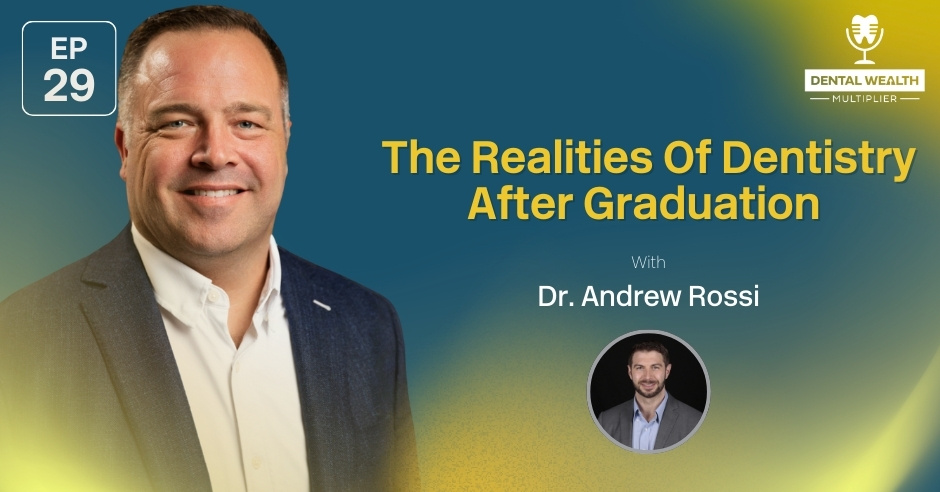
Jonathan Moffat sits down with Dr. Andrew Rossi, periodontist, researcher, and educator at Perio Health Professionals, to unpack the real challenges and opportunities facing new dentists after graduation. From graduating with $300,000+ in student debt to navigating associateships, DSOs, partnerships, and practice ownership, Dr. Rossi shares the strategies that helped him build a career in both private practice and clinical research. They also explore why geographic arbitrage matters, how to live like a resident to get ahead financially, and the role clinical research and innovation will play in shaping the future of dentistry.
Find Jonathan at jonathanmoffat.com
Learn more about Aligned Advisors at alignedadvisors.com
Find Jonathan on LinkedIn: linkedin.com/in/jonathanmoffat1
Find Austin on LinkedIn: linkedin.com/in/austinmoffat
Connect with Dr. Andrew Rossi on Instagram: @implantperiodoc
Catch new episodes weekly at dentalwealthmultiplier.com
—
Watch the Episode here
Listen to the Podcast here
The Realities Of Dentistry After Graduation with Dr. Andrew Rossi
This is Jonathan Moffat. Welcome to another episode of Dental Wealth Multiplier. I’ve got a special guest with me. Thank you so much, Dr. Andrew Rossi, for joining us. Dr. Rossi is out of Houston, Texas. Thanks for being here.
I appreciate it.
Periodontist, Researcher, And Educator Dr. Andrew Rossi
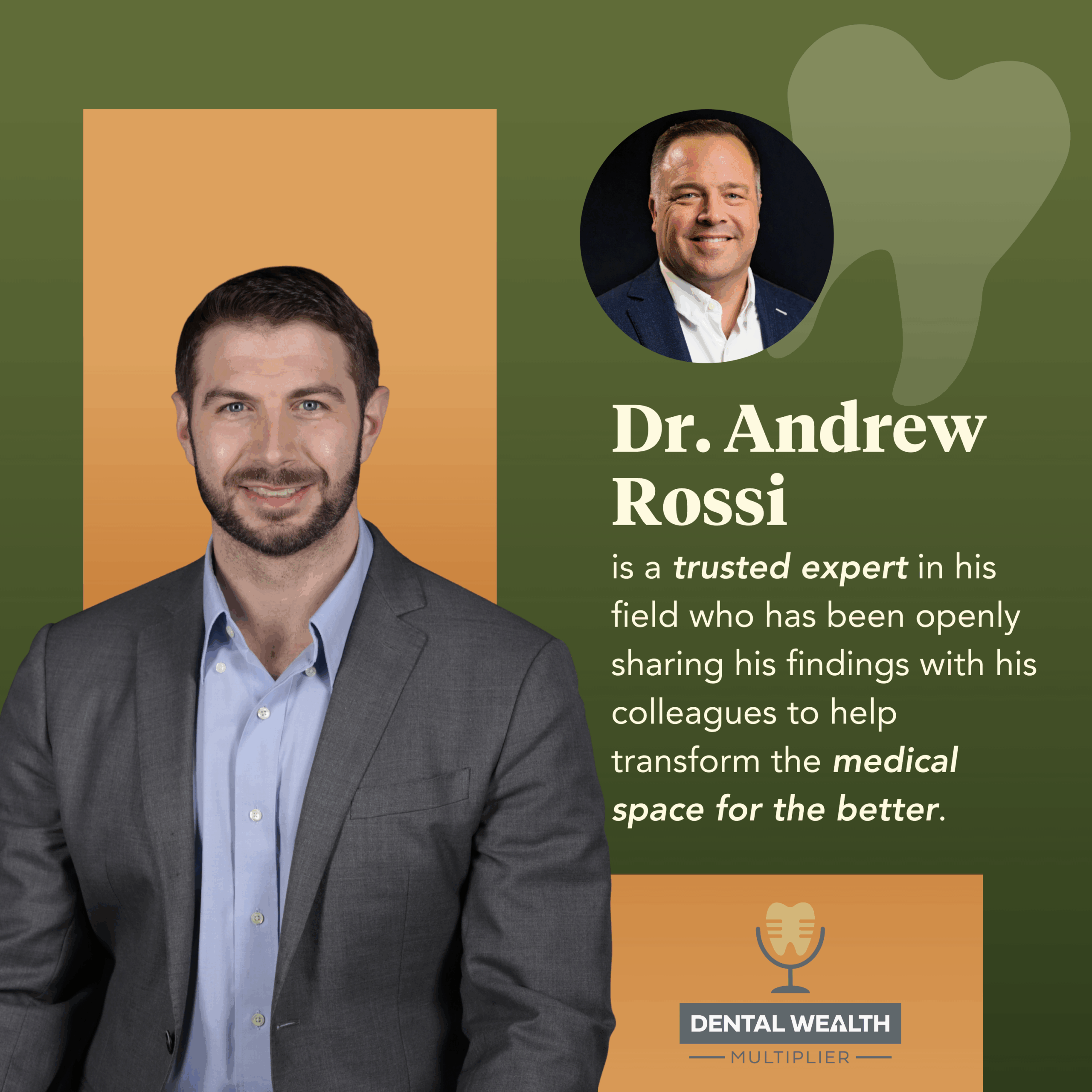
Dr. Andrew Rossi is a periodontist, researcher, and educator based in Houston, Texas. He earned his DDS and a Master’s in Dental Science and Periodontics from the University of Texas, School of Dentistry at Houston, where he now serves as a part-time faculty member. Since 2014, Dr. Rossi has specialized in regenerative periodontal therapy and soft and hard tissue reconstruction, leading Perio Health Professionals as one of the most active private practice clinical research centers in the country. His office is the flagship of The McGuire Institute and has performed more clinical research than any other practice in the United States. What are you passionate about? It looks like you certainly do a lot of research in your practice, and being a leader in the country is pretty impressive.
One of my favorite things to do is actually teach. I’m a giant science nerd. I’ve been doing it since high school. I’m an uber planner as well. When I was in high school, I started asking around. I knew what I wanted to do. I started asking doctors that I knew, “Who is the best in town? Who do I go shadow?” They actually pointed me to my office. Little do they know that twenty years later, I would actually be hired as a partner there. It’s pretty interesting.
I met my partner, Mike McGuire, back in 2002 or 2003. It has been a long time and a lot of planning. When I graduated from college, I knew exactly what I wanted to be. I wanted to go to dental school, but general dentistry didn’t excite me that much. I wanted some type of surgery. When you look at, let’s say, periodontists as opposed to other dental specialties, periodontist oral surgery tends to cut across the various professions.
What I mean by that is everything we do is backed by some type of research or some type of clinical backing, like the reason we make this incision. There’s always a study done. Naturally, as I went through dental school and got into my career residency. I gravitated more towards teaching and sports clinical research as a cool way to stay on the forefront of things, and see the latest and greatest.
I’m jealous because I was not that kid in high school, but it is interesting. I did not have a clear understanding or know what I wanted to do. I’m always very jealous of people who are like, “I knew what I wanted to do when I was in high school.” That’s awesome. It’s interesting. It sounds like maybe similar to you. I recognized and thought it was cool that successful people are good at what they do. I thought that was neat. I would interview these people. Thankfully, these guys were all cool, but I probably thought, “Who is this kid in high school who wanted to interview me?”
I always thought it was interesting that these people were successful. On a double date with this girl I was dating in high school, I went to see her. We went to pick up her brother’s date. They were going out together. His brother’s date was living with her uncle or someone, anyway. It was in La Jolla. This house was on the water, and waves were crashing. I’m like, “I need to meet this guy.” The only thing I could think of. “I’ve got to know what this guy does. What is this?” I think that’s cool that you had that curiosity as well when you were younger.
I know you know a lot of dentists, but a lot of us tend to be super focused for so long, which can be a scary thing. I have conversations with my wife sometimes about that. I noticed this even in college. The world is open to you, and then as you start studying more and more and start applying to graduate schools, things get narrower and narrower. It’s a little bit frightening when you’re twenty years old because you’re thinking, “Everything stands out for me. I don’t know if I like that,” as opposed to somebody like my wife. She is such a generalist. She could be happy doing so many other things, and the world is completely open to her.
From Medical To Dental School And Beyond
We need these specialists. There’s a reason there are specialists, and there’s a reason why I think it’s good that people like you want to go in and do the research and go deep and be that specialist. There’s obviously a need for that, and there’s a vital part, especially in the medical space. You went to a medical school, the University of Texas, Houston. You came out. It sounds like a crazy story. You had met your doctor, with whom you were going to be partners twenty years later. What did that journey look like for you through dental school? You graduated from dental school, and then what?
Like so many of my colleagues, I’m 40 years old right now, so straight up Millennial there. I graduated with a lot of debt. That pigeonholes me into what I need to do. To share my experience, I graduated with $250,000 worth of debt, which at the time was pretty normal. I was actually doing a little research before this conversation here. The average debt for the guys who graduate from 2024 and 2025 dental schools is $312,000.
It’s a decent amount right there. If you look at the payback, it’s about $4,000 per month. With that note, it came with restrictions. One thing we might want to do is start a practice right out of school. A lot of people still do, but I feel like it’s really hard with the note right there. There’s this emotional toll of having debts. We tend to delay buying a house or getting married, that type of thing. Contrast that to the previous generations that graduated with about 20% of the debt in real dollars.
It forces guys my vintage to have to work these jobs with a daily guarantee. That was the first thing. I started working in the corporate DSO wall, which has good things and bad things about it. One good thing is I got my rep. Talk about being a specialist. The way you become a specialist in something is the 10,000-hour rule. It’s doing the same thing over and over. I’ve got a lot of work, but it’s the deal with the devil sometimes. Maybe you’re pushed and doing things you don’t necessarily want to do. You name it. Any corporate names or anything like that, but I’ve experienced it.
That’s how I started. I started doing that, and then I started doing a lot of independent contract work, traveling from office to office, and doing surgeries, which I like. It was nice to have the freedom to do that and have an office in my truck. You talked a lot about this, too, from a business perspective. It’s nice to be 1099. There are a lot of good advantages to doing that.
In a lot of states, as many of those who listen to you now, you can’t 1099 now. It’s so difficult to do that as an associate. Certainly, some states are more lenient than that, but where I’m at in California, and I love other states too, that made it almost pretty much impossible to do that. To your point, you’re like, working as an associate, daily guarantee, and then on top of that, it’s like, and you’re getting hammered with taxes. As a W2 employee, as a higher earner, obviously, that’s difficult to swallow.
Texas was not in debt, either. This is an interesting strategy. What do you do about this step? What can you do to scratch this? One of them is geographic arbitrage. There’s a big need in a lot of underserved areas, where you are actually able to get paid more, even more so than in California. I love a big city in Texas. I live in Houston. It’s harder to be a private practitioner right in the middle of the city, wherever else you want to live, as opposed to maybe going out to the suburbs. There might be a better opportunity in places like The Valley in Texas or more underserved areas. In Texas, there are Houston, San Antonio, and Dallas. They try to incentivize people to move to underserved areas, but where are the vast majority of people? That’s Houston, Dallas, Austin, and San Antonio. It’s the big cities.
It is harder to be a private practitioner in the middle of the city where everyone else wants to live. Share on XI love that. Honestly, we see that too with the doctors we talk to. If you have practices and more rural areas, number one, if you are an associate, you can usually command a higher percentage or dollar amount because it’s very difficult to find doctors to go to those rule areas. I’m actually thinking of a couple of clients of ours in West Texas, Kansas, and places like that. They have these great practices that are profitable, but they’re rural. It’s hard. It’s two hours from a major metropolitan city, or an hour and a half.
It’s hard to get people to go out there. If you’re able to be more fluid or flexible with your geographic location where you can live, I love that geographic arbitrage. That’s a great term. I love that. You’re going to make more money because, usually, in those practices, you’re serving a larger population, less competition, so you’re going to do more dentistry. As I said, I know, at least our clients who are looking for doctors, they’re like, “I’ll pay more. I’ll pay a moving bonus. I’ll pay a signing bonus. I’ll pay for a CEO.” There’s usually a lot more that the owners are willing to give to get someone out there.
The patients in those areas that I have gone to before are super appreciative. I have an equivalent story. I had a good referral from a friend of mine whose first job out of dental school was actually in Forest County in Texas. It was actually part of a loan repayment. He moves out there. He set up, and within the first week, he got pulled over by the sheriff. He introduced himself to the sheriff. The sheriff said, “My wife is singing next week. Have a good day.”
I love that. You came out of dental school. You went in as an associate. You did that. What was next?
I actually got hired by a professor of mine right out of dental school. I was working at a great office. This is a wonderful doctor, but it was one of the situations where, after about five years of doing that, I learned equity itself. By then, I live like a resident for a while, which is another little strategy that tells me, “You need to do this. Live like a resident. Live below your means. You’ll pay that debt off, no problem. The $312,000 average debt, you can knock that out in two years.
I got to the point where I wanted to have equity in my office because I was building this mini practice within somebody else’s practice, but it got to a point where he wasn’t willing to sell it. It was very fortuitous around then that my current partners gave me a call and said, “We’re ready for a third partner,” against it. Going back almost twenty years, seeing what these guys have done and knowing their reputations, I was super psyched. In 2019, I came up as a partner here at Perio Health Professionals in Houston.
That’s great. I know your faculty at a dental school. What do you do? What does that role entail, and how do you help the students that you work with?
I get my time back at this point. I feel like I was getting a lot from the dental school here in Houston. Good opportunities happened through there. I’m a faculty but I don’t get paid for that. I volunteer my time. What I do is give lectures on either prognosis or clinical research. It’s what’s going on right now on the fourth of technology that we’re testing here in Houston. I’ll go once every few months and give a lecture there.
Dr. Rossi’s Advice To Younger Doctors
What’s your advice to younger doctors? If you’re talking to a third or fourth year student who is looking at coming out with this $315,000 debt average, and we see numbers much higher than that, what is your advice to them as they’re coming out of school? I know we’ve talked a little bit about the geographic arbitrage. I love that term. What else would you tell? I love the live below your means. You are echoing things that we talk about all the time. I love that. What else would you advise them as they’re looking at what the next phase of life after school looks like?
First off, it’s going to be okay. Dental school or medical school is still a awesome deal. Even though we’ve got to invest north of half a million dollars into it, it will pay off, especially if you live like the rest for a number of years. Also, be very intentional about every job you end up taking. Be very intentional about the CE course you take. What I mean by that is to calculate the ROI of this in terms of the CE course.
Don’t go just because it’s Vegas and you’re going to have a good time. Go because you’re going to learn some interesting procedures that will enable you to stand out a little bit and offer something a little bit different to either an employer or to your patients. With the job, negotiate your salary. You’re worth a certain amount, and you studied very hard for this. Don’t settle for the first thing, and renegotiate.
Learn how to negotiate your salary. You are worth a certain amount. Do not settle for the first offer you will get. Share on XA couple of things came to mind as you were sharing that. One is that we tell doctors all the time, you’re a vital part of this. As an associate coming out, there are a lot of these bigger groups, and even single-location owners who need associates to come in. They need these associates. They need you to come in and help them. You’re going to bring something to that practice that the doctor needs. You do have a lot of value that you’re bringing to that practice.
As you’re talking about being purposeful too and being personal about your CE, being purposeful about the jobs you take, this is lifelong. I’m still trying to be better at this. A lot of us have a hard time putting a dollar amount around what our time is actually worth. It’s easier to do a daily guarantee or a percentage of adjusted production or collections, but your time is worth a lot. What you do with that time can significantly speed up or slow down your progress or growth towards achieving your goals.
For example, I love what you said about you’re going to go to the C course. I do a fair amount of speaking. I know you’ve seen me speak. I go speak to groups. You’re here. You’re in this room. If you’re here, put down your phone, put down your laptop, and focus. Learn something. Write something down that you’re going to take back and implement, so that you can move yourself forward. I’m certainly by no means perfect at this either. We find ourselves in these situations. It’s like we check social media. We lose the opportunity or miss the opportunity to take advantage of this time. Maybe you’ve closed your office down half a day or a day to do this. That’s expensive. You’re not seeing patients.
You almost can’t get paid enough to close down your office for a day. I took a fair number of CE classes. Those are probably the best things I’ve ever done when I graduated. I sought out the best in the world. Would you grow up for a lot of surgical courses when all of the US got to do things? I never went through it in school. As wonderful as my education was, there are gaps in every step. You need to go out and seek the best. That was the best ROI I am getting, but I’ve always got a little rule when I’m taking a C class, whatever type it is, whether it’s a business class or a clinical class. On Monday morning, we have to implement something. Frank Spear said, and I’m paraphrasing, “Education without action is just entertaining.”
No matter how wonderful your education was, it still has its gaps. You need to go out and seek the best. Share on XWhenever we have our live events, or we present, I’m always encouraging and even giving a format and a formula for, here’s how you should take action. What are the actions in priority order that you’re going to take back and implement? Obviously, if you’re an owner of a practice, do you have that team that supports that vision? That’s huge.
That’s the best thing about bringing your staff to a lot of courses.
You said to be thoughtful. Do you have any tips, input, or advice for how you would select or choose those C courses wisely for anyone listening?
I would take a look at young Brad starting their new job as an associate, corporate BSO, private practices. It doesn’t matter. Find something that the other doctors in that practice are not, whether it’s learning how to place implants or do molar endo. Know what this guy doesn’t like doing. Maybe I’m the only periodontist in Houston who is doing zygomatic implants. When a patient wants something like that, who’s the expert? It’s me.
The Rise Of Female Dentists Today
Make yourself invaluable and irreplaceable. I know there’s definitely a massive need. The curve is like this for the need of associates. I’d be curious to get your take on this. I was on a call with a gentleman who said, “My brother is in dental school right now. He said that 72% of his class are female dentists.” How do you see that in terms of options and growing practices? How do you see that impacting dentistry and the trends that we’re seeing within your practice or other practices?
My class was about the same. It’s maybe 65% to 70% female. What I see on a private practice level, like it or not, our society is putting an awful lot of pressure on moms to stay home with kids or to do the vast majority of the childcare. There’s society there, so it makes it that much harder. I’ve got way more respect, now that I have a young child, for the female doctors out there who are running a practice, working four to five days a week, and taking care of their kids. What is that going to do demographically? It may push us away from having a single practice owner. It’s going to be more of the DSO corporate model or partnerships. I know several offices where there are two females. It is a great way for moms to be able to work, as well as be able to take care of the kids.
I agree. We even see clients who do that partnership model, where there’s an opportunity to buy in. For doctors, male or female, who want to have more support on the back office side of things, partnering in an office is a great way to leverage that and have actually more free time to do other things you want to do, whether it’s spending time with family or other hobbies or activities. I was curious, with your interactions with the dental school, are you seeing a similar trend? Certainly, from what we’re hearing from a lot of people, that’s a big trend right now.
It’s also pushing people to form their own small, little, mini-DSOs as well. The back office duties, the accounting duties, and all the things that dentists, practice owners know that maybe we were trained to do this. If you start combining forces, which is actually what we did with our practice model, we started combining some of our best referrals to share a lot. It has freed up a lot of time on our end as opposed to hiring a CEO or CFO who might be better trained than us to do this.
Delving Into Dr. Rossi’s Clinical Trials And Research
Let’s talk about your clinical research. Tell me about that. Where do you spend most of your time? What are some projects or research that you’re doing right now that you find interesting? What impact do you think that will have on the doctors who are tuning in, and how can they implement some of those techniques or things you’re researching into their practice?
Just a little background first. My partner, Mike McGuire, started doing some research back in the ‘80s. In our tiny little world, Mike McGuire is very famous. He’s famous initially from doing these studies from our practice population on, let’s say, the prognosis of teeth. That has evolved into more products in 2014, called The McGuire Institute. It’s a collection of seventeen offices from around the country. Companies will come to us with new products, new implants, new bone grafts, and new soft tissue material.
What that lets us do is design a randomized clinical trial, using your office or the flagship office. We’ll do a pilot study with, let’s say, 10 to 15 patients. What that allows us to do is test out the product, make sure it’s okay, and it tells the companies, “If there are good results, maybe we want to increase the number of patients in a setting.” From there, we go to our seventeen other sites all over the country and increase the number of enrolled patients. It’s a quick way to do it, and say, “Give me a single center or university.”
Unlike a university, these are real-world patients. These are private practice patients. Dentists who are tuning in know that it’s not the dental school patients who come in. That’s just not. One way or another, it’s not. Also, when you’re doing studies, there are so many variables that you try to control. People don’t listen to post-up instructions as they should. Maybe they’re not as healthy as they claim to be. When you’re in private practice, and you put these practice patients, you get more real-world data out of it.
What this means is faster adoption of technologies. I’ll give you a good example. Dentsply Sirona Astra’s latest implant, before it came out, we actually put out a more popular implant that surgeons use. That got through the FDA. That got tested a lot quicker because it went through the private practice network rather than going through the universities in Sweden or Germany?
Is there anything you’re testing or you guys are running clinical trials on that you’re excited about, or a new technology that’s going to revolutionize or change the way we do X, Y, or Z that you’ve seen?
Little steps right now. One of the coolest things that we’re testing at the moment is a bone graft product. It’s a bone graft product that actually is very cheap compared to the traditional graft that we do. It’s available commercially. A lot of people look at it and poo-poo it because it looks like cheap stuff. The question is, if you use that and compare it to, let’s say, an allograft that we use on a normal basis and take biopsies of it, is there a difference?
From there, you can actually calculate and say, “Maybe this would be worth changing to, from a clinical perspective, from a monetary perspective.” There are also some interesting periodontal treatments that we’re trying, which involve different devices that you actually put in the mouth. Those are patent-pending things that hopefully we’ll get through the FDA. Let’s see if this helps.
It has to be fun to be a part of those trials and see what makes it through, what doesn’t make it through? I’m sure that’s going to be a lot of fun.
Seeing the business perspective of it is pretty cool, too. You meet with these VCs who invest money to help develop that. You’ve got the inventors of the products. These mad scientists guys. It’s this motley crew of fun guys all getting together, trying to help out patients.
We interviewed Dr. Jeremy Krell with Revere Partners. These are big VC firms in the dental oral health space. We were talking about a couple of technologies and new things that they’re seeing and that they’re working on. That part is exciting. I was in a conference, and there was a lot of talk around AI and all the rapid advancements that are happening not only in the medical space, but specifically in the dental space. It’s really exciting.
One of the AI updates that we’ve implemented, which is actually a study we did, was a digital hygienist. We basically input all of our hygiene data for the last 40-something years into this digital hygienist prompts patients, like, “You didn’t floss today. Did you check for A1C this month?” It was the same company that ended up prompting Toyota to save money with another assembly line, and the drivers. They are giving drivers notifications. “Look at the road. Look up,” and see these accidents.
This is like something on your phone that would prompt you, like, “Did you do this? Did you do this?” You then go check the box.
Exactly.
The AI piece is fascinating. What do they say? It’s like 32 AI-assisted x-ray and radiograph-assisted programs right now. Thirty-two different companies are doing AI-assisted imaging, which is going to be an invaluable tool for clinicians, like yourself, to get better insight, more clarity, and more visibility into what is going on with that patient.
More importantly, I see that these AI applications, especially when looking at radiographs, patients see black and white, nuances that we’re trying to see. With the AI programs out there, the radiograph will actually point out that these are carriers right here. That’s calculus. It’s a very educational tool for patients. That’s the biggest benefit that I see.
It’s neat as it continues to advance. For those owners and doctors who take advantage of that, this goes back to what you were saying earlier about becoming the best by becoming a specialist in whatever those areas are. That includes looking at how you can use these technologies, different procedures, and other products and services that are coming up at the forefront. Doing that research, again, going back to your point of being purposeful around picking CEs.
If you have that focus of saying, “I want to be the best in my area,” or “I’m very passionate about this specific area of dentistry.” If you go deep and learn about what products and what things are being tested out there, you’re going to set yourself apart as the expert in your area for that specific vertical that you’re interested in or that you’re passionate about.
Whatever else, this is differentiation. Whether I’m the best at doing this or I’m the only one doing this, it doesn’t even have to be the best at this. Maybe I treat patients really well. That’s something that sets you apart.
You do not have to be the best to do something. You just have to do something to set yourself apart from the rest. Share on XSetting Yourself Apart From The Competition
It’s interesting because you’re in a large city. I’m in Southern California, a large city. You always hear about high population, a lot of competition, and lots of dentists per capita. How do you set yourself apart? There’s that book I’m sure you’ve read, Blue Ocean Strategy, one of those books I read many years ago? How do you look for the blue ocean as opposed to the red ocean, where there is a lot of competition? It’s interesting because I know people even in our space who are consistently looking for, “How do I set myself apart? How do we create a blue ocean or find a blue ocean?” There are a lot of blue oceans out there.
You wouldn’t know this, Dr. Rossi, but several months ago, we did a podcast, and then we did a mastermind around the Savannah Bananas. We talked about how they’ve changed and innovated baseball, which has been around for hundreds of years. People are like, “You can never change baseball,” yet they’ve figured out how to create this niche inside of baseball. That’s wildly successful. You can do and there are a lot of people out there doing this very same thing in dentistry.
Maybe it’s a nice office you go to or some unique aspect. Maybe, in our case, it’s the private practice research, where we treat patients for free, so we can make call-outs for referrals and say, “We’re looking for patients who need extractions, but they couldn’t afford it. Send them our way, and we’ll get it done free.” It’s a benefit for the patient. It’s a benefit to your practice, and it’s a benefit to science overall.
Dr. Rossi’s Message To Newly Graduated Dental Students
They look like a hero to their patients. “By the way, that extraction that you need. We have a group that will do that for free.” That’s pretty awesome. What would be your advice, then we could shift back to the new grads. Startups are something we’ve had a lot of conversations about recently. People who want to do startups. Their first practice out of dental school. You were sitting down cross table from a new grad. What would be two or three things you’d say, “Do this, do this, do this?”
Location, location, location. That’s really what it is. In Houston, specifically, I would go to the suburbs, especially growing areas. I’ll go to the underserved areas of whatever state you’re in, or even larger-sized cities and places like the Midwest that are completely underserved. One of our good friends, co-researchers, and part of our institute is an amazing periodontist in Omaha, Nebraska. He’s killing it in Omaha, Nebraska. People think, “I don’t know if I want to move to Omaha.” He has such a good life there, a very vibrant practice, and is very successful. His cost of living is probably a third of what you and I spend. Life can be great that way.
If you’re willing to sacrifice, because you even talked about it on the front end, instead of delaying buying that huge house or that fancy car.
Drive that car into the ground for two more years. Live like a resident. You’ll be amazed at how good of financial situation you can put yourself in just by living less than you earn.
The reality, and you know this, is that your earning power only goes up after you graduate from middle school. It goes up, and as you get better and then you get your own practice, the biggest anchor that you could tie to that upward curve is a ton of even more debt, bigger house payments, big car payments, and spending. That’s the biggest anchor you could do in. I love to look at best practices. I love to look at people who have created a tremendous amount of wealth. What are those habits that they’re doing? It’s almost always living below their means. They may have a nice house eventually. If they do, it’s a point where they can easily afford it. They’ve already set themselves up to be successful. Those habits, if you can ingrain those into yourself at an early age, in dental school, and after dental school, you’re going to set yourself up for success.
There’s a statistic that something like 45% of doctors in their 60s don’t have $1 million net worth. That’s shameful with the big shovel that we’re given to dig ourselves out of a financial situation. Investing early is something that I would tell people. Get a good CPA. My CPA happens to be my father, who is amazing, and who I learned things along the way, like little tax return tips.
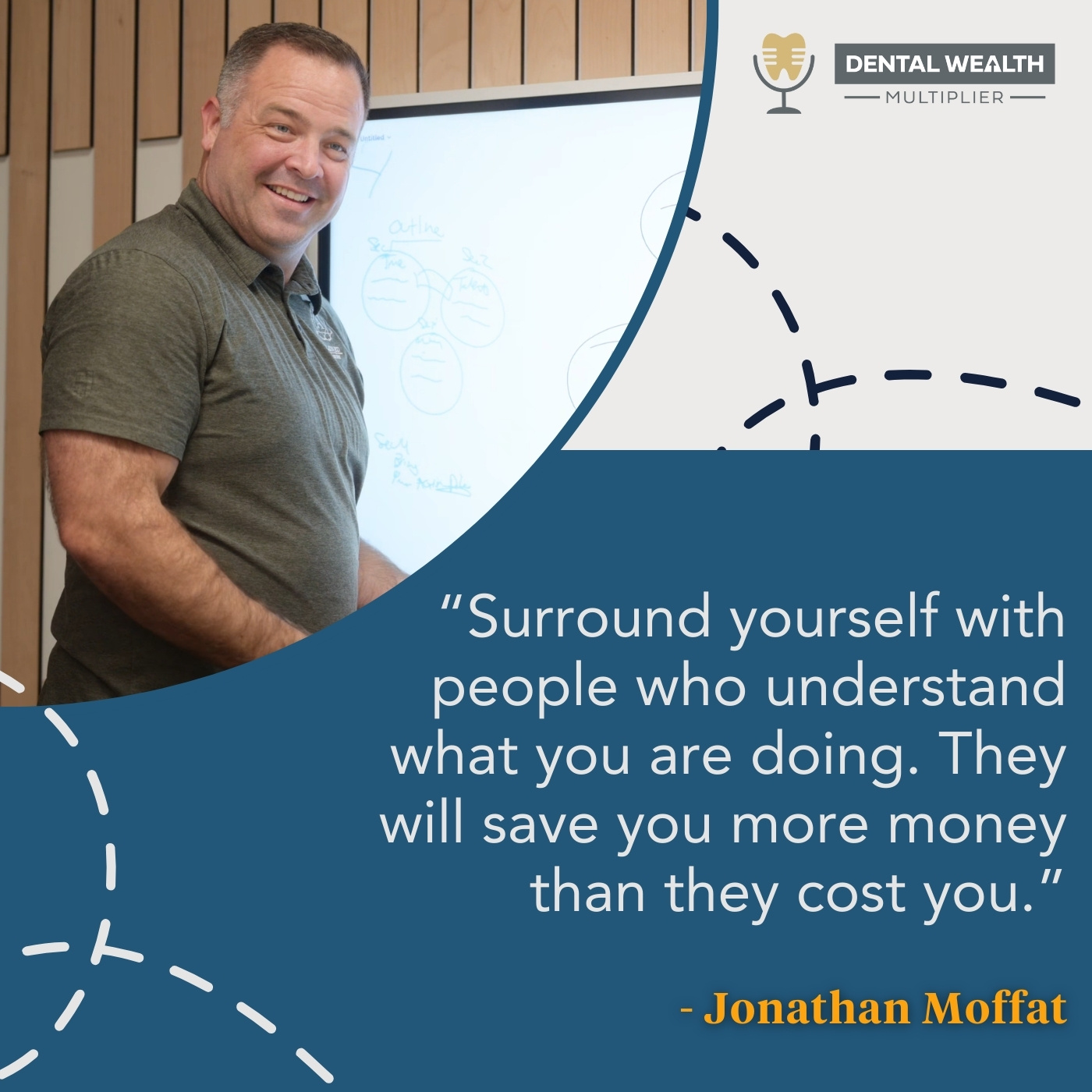
Start off with the team that understands your space. We talked about that too. It’s all about who you surround yourself with, people who understand dental, know what you’re doing. It’s important. They’re going to save you more money than they cost you. This is going back to creating those disciplines early is going to set you up for success in the long run. The ADA did a study a couple of years ago. It said that less than 5% of dentists actually have a plan for retirement or for their financial plan. The dentist’s biggest asset is their practice, and so it’s this interesting dynamic that we’re seeing in the space, where seven or eight years ago, we were seeing huge valuations for practices.
DSOs are spending all this money on practices with multiple big exits. That’s not the environment or anything. I was out at a conference, and a lot of conversations were about valuations, private equity, DSOs, recaps, and what’s that going to look like? The short answer is, it’s a lot less. The numbers are a lot lower. The multiples are a lot lower. The money is not where it was a few years ago. This is thinking through and making sure you have a plan for what my exit or my transition into this next phase looks like, and having a plan for that.
I absolutely would not rely on my practice for full retirement. There are too many people, especially right now, who have built up the babies, the practices they’ve had for 30-plus years. They think they’re going to sell that and live on that for the rest of their lives. They’re finding that when you start calculating things on a keep it up basis, and then apply a multiple to that, maybe it’s not worth what I thought it was. I’m not going to be able to retire on this. Do I have to keep working for one more year or two more years, then push it back? You need to say as soon as you can, “Do not be reliant on that practice for the rest of your life over time.”
You need to be saving from an early age. Do not be reliant on your job for the rest of your life for retirement. Share on XIt’s a great asset. It’s the best cash income-producing vehicle that you can have. I’m a big believer that as long as you’re working in it and you’re growing, the best place you can invest your money is back into your practice.
Get In Touch With Dr. Rossi
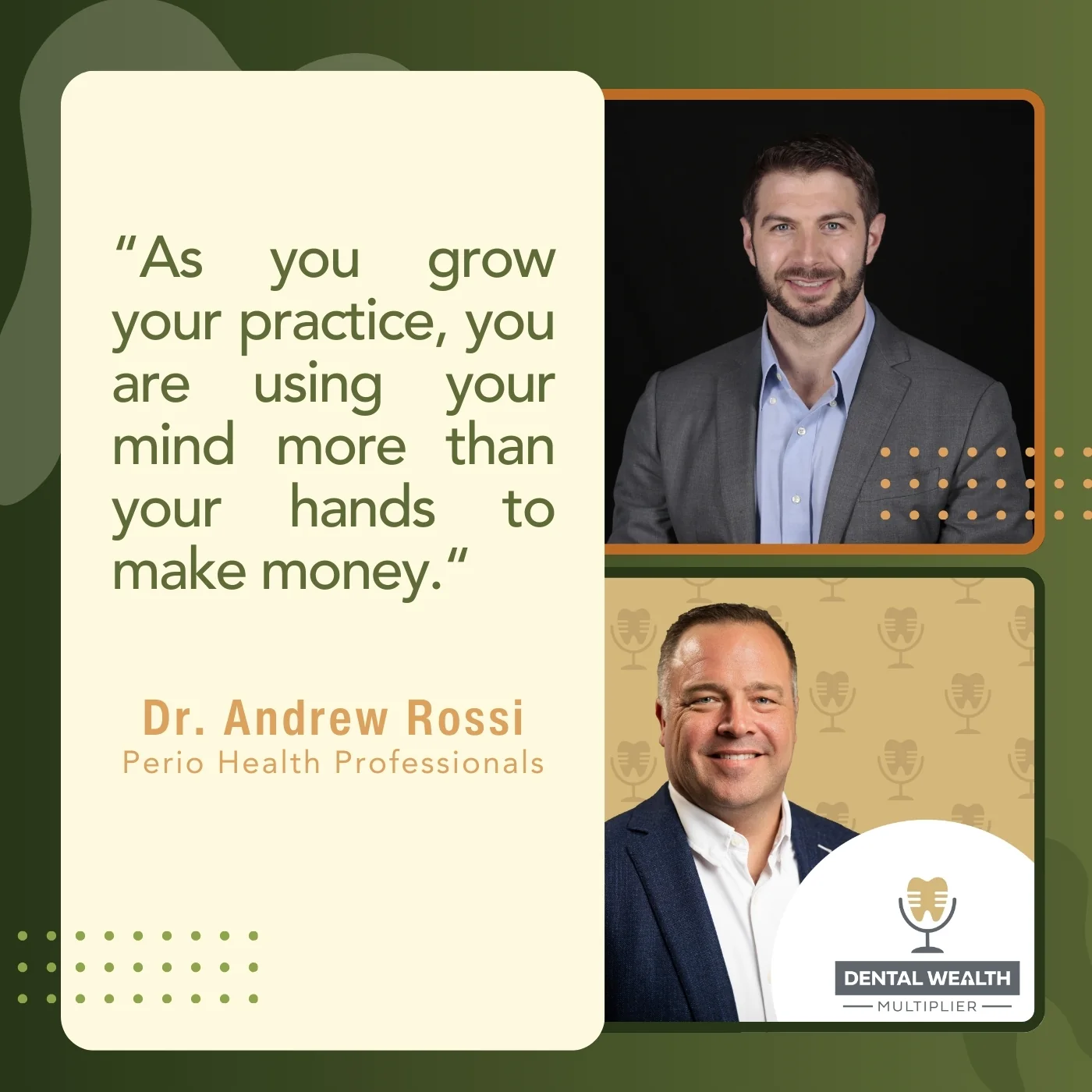
As you grow your practice more and more, you’re not necessarily using your hands to make money. You’re using your mind to make money. You’re taking a lot more managerial type role instead of being an hourly laborer. You’re a highly paid hourly laborer, but an hourly laborer nonetheless. You make a lot more by managing people, keeping your hands skills going, and growing that way.
For sure. It’s an entrepreneurial journey. You start as a dishwasher, the person doing everything. You then slowly graduate and learn more. Ultimately, as you’re shifting, hopefully, up and out of the chair, fewer clinical hours and more time overseeing and involved in actually running the practice, and more of overseeing the strategy is where you’re going to see a lot of leverage and growth opportunities within your practice or practices for that matter. Dr. Rossi, where can people go to learn more about you, connect with you, see what you’re up to, and follow all these different avenues that you’re putting effort towards?
The best place is at PerioHealth.com, or my Instagram handle, @implantperiodoc.
Dr. Rossi, thank you so much for coming on here and sharing this great insight. I love the fact that you’re in the schools, seeing firsthand, doing these clinical trials at the forefront, clearly an expert in your own field and in your own right. At the forefront of a lot of that is invaluable. The insight that you have and share openly and freely with your colleagues is invaluable. Thank you for coming on and sharing that with us.
You’re welcome. I love teaching. I love doing many things like this.
Thank you, Dr. Andrew Rossi. Thank you, everyone, for tuning in. Until next time, we’ll talk to you later.
Important Links
- Dr. Andrew Rossi on Instagram
- Perio Health Professionals
- The McGuire Institute
- Blue Ocean Strategy
- Savannah Bananas
- Jonathan Moffat
- Jonathan Moffat on LinkedIn
- Aligned Advisors
About Dr. Andrew Rossi
 Dr. Andrew Rossi is a periodontist, researcher, and educator based in Houston, Texas. He earned his DDS and a Master of Dental Science in Periodontics from the University of Texas School of Dentistry at Houston, where he now serves as a part-time faculty member.
Since 2014, Dr. Rossi has specialized in regenerative periodontal therapy and soft and hard tissue reconstruction, leading Perio Health Professionals as one of the most active private practice clinical research centers in the country. His office is the flagship of the McGuire Institute and has performed more clinical research than any other practice in the U.S.