
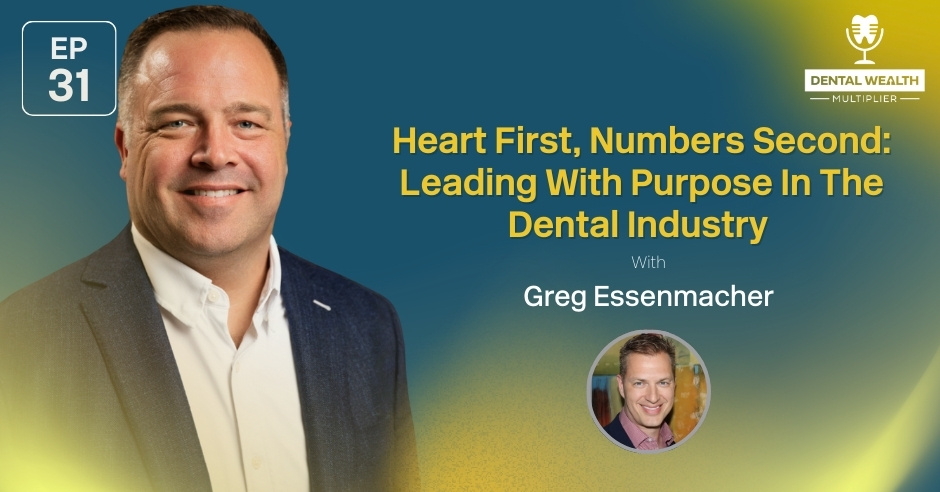
In this episode of Dental Wealth Multiplier, Jonathan and Austin sit down with Greg Essenmacher for a powerful conversation on heart-first leadership in the dental industry.
In Heart First, Numbers Second: Leading with Purpose in the Dental Industry, Greg shares insights on what it truly means to lead with intention—focusing on people, culture, and long-term impact while still building profitable, sustainable practices. The discussion explores leadership beyond production metrics, creating alignment within teams, and making decisions that support both professional success and personal fulfillment.
Find Jonathan on LinkedIn: linkedin.com/in/jonathanmoffat1
Find Austin on LinkedIn: linkedin.com/in/austin-moffat/
Find Jonathan at jonathanmoffat.com
Learn more about Aligned Advisors at alignedadvisors.com
Learn more at https://www.dentalconsult4u.com
—
Watch the Episode here
Listen to the Podcast here
Heart First, Numbers Second: Leading With Purpose In The Dental Industry With Greg Essenmacher
Looking Back To Greg’s Career Journey
We are so happy to have with us a special guest, Greg Essenmacher. Greg, tell us a little bit about yourself. What brought you into dentistry? Let us jump into it. I am excited about our conversation.
It is always fun to hear the origin story of how people ended up in dental. I backed my way in to tell you the truth. I was in a rental car, and the regional company I worked for was sold. I had already started looking for something in medical. I was looking at Stryker and possibly pharmaceuticals. Thank God I did not end up in pharmaceuticals. No offense. No shade on pharmaceutical sales folks, but it is all true. Everything you have seen in the movies is true about pharmaceutical sales reps.
I found an ad on Monster.com. I have been in dental for many years, and it was for dental. I went for the interview. I was one of eight people. At the end of the interview, a guy named Rick said, “I’ve got seven other people after you who all have experience in dental. Why should I hire you?” It was one of those moments where I stood up and said, “It’s because a year from now, you’ll wish you had five of me.” I shook his hand and walked out the door.
It was at the Embassy Suites, Phoenix Airport. It was in the front room. Embassy Suites have two rooms where the front room is like the living room, and the bedroom in the back room. It was creepy to start with. I got the job and that is how I found my way into dentistry. I have never left since. I am a resourceful guy. It was a bone grafting company.
I work smarter and not harder. I looked at the time, the number one dental implant company was Nobel, and they did not have any biologics. I found every Nobel rep possible and said, “Do you want to stop losing business because Zimmer is getting their biologics in and then backdooring their implants in and stealing your business? Let us partner together. Every single program you have, bring me in.” That is how I found my way into dental, and I have not left since.
That is smart. That all led up to now. Now, what do you do?
The bone grafting company ended up selling, and the Straumann Group called me when they were launching their implant line for the value segment called Neodent in 2014. Most people know that. I helped launch that brand, built it up to $100 million four years ago, and said, “I could do this on my own,” and I started my consulting brand, GnA Consult, helping practices to capture, convert, and close leads in the full arch lane from single locations to DSOs group practices. Do it more profitably and do it more sanely with systems and processes. That is what my coaches and I do at GnA Consult. I have been doing that for a few years now, which has been just an amazing ride. I am super grateful to the industry. I love doing it every minute of it.
Focus Less On The Shiny And More On Profitability
Thanks for sharing that. Full Arch is gaining a lot of traction and light. I own eight practices in Southern California. Full Arch was something that was a part of all of our practices. It seemed like every marketing company out there was like, “We’ll get you more marketing leads. We’ll get you more All-on-4 or All-on-X. We’ll get you a full mouth.”
You have to be careful. If you say All-on-4, Nobel is going to come after you because that is trademarked by Nobel. You can say All-on-4 all you want. Nobel, I know some people over there. I want a piece of that.
No such thing as bad press. Let us go bring it. Let’s start there. It seems like we hear from clients all the time, “We want to do more of these full mouth restoration or these full arch restoration cases.” How do we get in front of the right patients? How do we close these? How do we do more of these?” They start doing the math on this. Austin and I were on a call with a doctor of ours.
“Shiny keys. $20,000, $30,000, or $50,000.”
They’re like, “I only have to do three of these a month, and I just doubled my revenue.”
“I’m not doing any more hygiene or drilling. I’m just going to do 3 or 4 arches a month. I’ve got myself a $1.4 million a year practice. I’m the best there ever is.” Until you’re in 4 to 5 prototypes and you’re losing money on every case. It is so indicative of chasing after that shiny key. It is the squirrel. I call it shiny keys. We all have an acronym for it or a saying for it. It is true if you can and if it is scalable. The challenge is that everybody started chasing after it.
You talked about having eight practices in Southern California when we launched the Neodent brand into the market. Our niche was going after the GP market that had a GP side of the business, and also did implants and full arch. It is a huge industry. It is a $1.6 billion a year industry, implants and full arch according to Polaris, and growing by 3% to 5% a year. It is attractive, which means more and more people get into it.
In Southern California, where your eight locations were. When we launched the brand in 2014, Southern California was a wasteland. Nobody was doing a full arch. Nobody was doing All-on-X. There were a few, but it was untapped where some of the other urban markets were much more saturated in doing this procedure and much more advanced in doing procedures as far as GPs and single-house providers as well. That’s what I’ll call them.
That is where we honed our craft of being able to attack the market and where it matured quickly. Not just in the DSO space. We are not talking about the newbies of the world that came out a few years ago that attacked the market well. That profitability piece gets missed so much. It is a huge part of what we do at GnA Consult. It is not just about your top-line revenue, but how profitably you are doing it.
What are the systems and processes you can put into place at every touchpoint of the patient journey? What metrics are you looking at that matter? For what you’re talking about, these marketing companies, the capture part of the leads will bring you to, how many leads do you want? How many are going to convert into consultations that show up that are buyers in the chair that you can then close that can afford to do this procedure and move forward, that are not your problem patients?
Are you asking the right questions along the way? That is the landscape of full arch today compared to even a few years ago. When money was flowing freely, the government was giving everybody checks. You were incentivised and paid to not work. Credit scores were good, and the debt-to-income ratio was much better. That is not the landscape for most. They need to be savvy for profitability and Full Arch is so much more intricate. That is where we come in.
Rather than being a permanent fixture on the payroll or a one-and-done where I do a one-day course for you, and we all know that staff members do not implement and are not accountable afterward. Clinicians are clinicians. There is so much to it that is so critically important to do it well and sustainably in practice, which then adds value to the practice. That is what I know that clients of ours are looking for at the end of the day.
Biggest Mistakes Clinicians Make (And How To Correct Them)
Greg, you touched on it a little bit, but let us dig a little bit deeper. Where do you see as the biggest missteps or mistakes that many of the doctors are making when they want to either maybe they have done one, or they have heard about one? They go to a study club, and they hear one of their buddies go, “I did a $30,000 case or a $40,000 case last month.” They are like, “I want to do a $40,000 case.” They start tiptoeing into this space. Where do you see the biggest mistakes being made when they do that?
It’s asking the right questions. There are so many companies out there, and I am not going to put all of them on blast. What so many clinicians who are starting, and that is what I am hearing you say, those who are starting or wanting to go from having done a handful of cases because of a neighbor’s sister, uncle, brother, or in their own patient files. I have done a few of these because I am clinically competent in them. Now I’ve got a taste for it, and I want to do a lot more.
I have those discovery calls with clients and prospects all the time. It’s like, “I’m going to go with this company. I’m going to pay them X amount of dollars per month, and they’re going to market for me. They’re going to put the consultations into my books for me. They’re going to take care of everything. They’re going to come into my practice because I can sell.” “Mr. Doctor, I can sell. Once they come in, “I can sell the case.”
What happens is they get six months down the line or a year down the line, and they have spent $60,000, or $80,000, or $100,000, or $120,000 in marketing, and they have not done a single case. They’re super frustrated. Maybe it has to do with the blazing fire, and it is a gang of people, or maybe you put an ad in the media. Not that I’m putting on blast any particular companies. Read between the lines. These are companies that are a dime a dozen that are out there.
The biggest mistakes are that you cannot cede authority for every step of the process. There is no magic bullet. There is no magic wand in a full arch. There is not. It does not mean that you have to go out and hire somebody full-time for this position, but you need to understand the process of the patient flow to be able to be responsible for what differentiates you in the marketplace.
There is no magic bullet or wand in a full arch. It does not mean you have to go out and hire somebody, but you need to understand the process of the patient flow. Share on XIf they are going to drop $20,000, $30,000, or $60,000, why should somebody select you over the guy or gal down the street? What is that in you? What makes you different? Be able to identify that. That is being able to partner with a marketing partner that understands you. When it comes to marketing, who do you have that is going to convert that lead in your practice and have the conversations? Both of you know. You work with dental practices all over the place. This is not a new patient hygiene call.
That 60 to 90 seconds, name, rank, serial number, put them on the books, come into the hygiene chair, maybe a loss leader because we are looking at the full-time value of the patient. This is an emotional connection with the patient. This phone call, once you get the conversation with the patient, has to be a meaningful conversation where you build trust with that patient.
Once you build that trust with that patient, because they are probably full of shame. Full arch does not happen overnight that suddenly they have a bombed-out mouth. Building trust with that patient so that they want to show up and are incentivized to show up is key. There are many gadgets to be able to overcome that. “We’ll take a deposit,” then there is skin in the game, or whatever way that they want to.
You still have to make that emotional connection with the patient to show up. There are plenty of marketing companies that will buy that lead to show up in the chair. That is not an incentive either. It is that connection to show up in the chair ready or at least ready-ish to be a buyer in the chair and open to, “What does next look like?” The work begins in the clinic.
Most think that once I have got the patient in-house, in the chair, that is where the work begins. The truth is, the vast majority of the work happens prior to, then the work begins with consistency. That is critically important. That is one of the biggest mistakes. The second is, once they get in the clinic, the lack of consistency in the tools and thinking that, “We will get them financed through a third-party financing company.”
Truthfully, only about half use the traditional third-party financing company. You guys are finance guys. You know it, and you do it for businesses, but it is the same for patients. I’m going to ask this, and then I will turn it back over to you. Anyone who is doing full arch out there, any clinicians, any group, I want you to answer this question now.
If you were to go to your treatment coordinator now and ask them the question, “When you’re sitting with a patient, what are the top three financing pieces of your ladder that you have now? What are the APRs typically, if a patient were to ask you? Can you offer them now and walk them through each of them and what it means?” If they cannot answer that question, then you do not understand the financing options that you have for your patients, period.
That lack of knowledge is the other big mistake because then they do not have the confidence, and sales is confidence. Conversion and sales because you’re in sales. For a huge case, a commitment that is going to be 8 or 10 years for something that is literally a car payment or maybe a home payment. It depends on how big the whole mobile home is. This is serious stuff. That is why they’re not winning at this game, because it is a game at times.

How Doctors Should Learn To Relate With Their Patients
You have listed a number of things. All are valid. You’re speaking to a new client. What is the primary typical issue or problem that you see going into your average doctor or practice when you go in there?
To pinpoint the one, the biggest one that we see initially, or at least the primary one that we need to attack initially is the conversion of the leads. It will happen prior to or after. There are usually 1 or 2 hiccups that happen during that, because a lot of times, it is not these monstrous problems. Typically, it is working with our lead call coaches who are trying to convert those leads with our clients who are handling the leads. It is the small things that are happening.
We have ways to overcome that. It is our online training where we are listening to calls and coaching on that through our weekly online training sessions. It is the backups, the scorecards, or the Loom videos, because there is nothing like hearing yourself. I do not know about you all. You have a show and you probably hear yourself. The first few times, you’re like, “That’s what I sound like?” I do too. I have done about 140 episodes.
When you first start to hear yourself, you’re like, “That’s what I sound like?” There is nothing like learning from yourself and your own words. When they hear it back to themselves, that is why there is the “I don’t say that. I don’t do that.” Do you understand what empathy is? I am going to call it out. A lot of the individuals who are being hired and put in the seats to answer these calls and make the connection with patients who are in their twenties.
There is nothing like learning from yourself and your own words. Share on XNothing against them. My daughter-in-law is in her twenties. The truth of the matter is, most who are in their twenties, when you’re talking to them about empathy with a patient who calls up and says, “I have an upper plate on the upper right-hand side and it hurts every time you put it in. I don’t wear it anymore. I haven’t worn that plate for a couple of years.” Somebody in their twenties cannot relate to not having their upper teeth. They just cannot.
However, that irritation, if you can teach them and say, “Think about irritation. What irritates you? Do you have any siblings?” “I do. I have a younger brother and a younger sister.” “Do they ever bother you? Do they get under your skin?” “All the time.” When you hear someone talk about an upper plate and they have irritation in the upper right, so they do not wear that plate. Think about your younger brother or sister who is irritating you when you’re on your phone, or you’re going out on a date.
That is empathy. They can relate to that. That is the coaching. That is the relatability. Being able to help them understand and connect dots is everything. Those are the small pieces. When I say it is not the big things, it is the little things, and then it is the accountability. It is then listening to phone calls and saying, “The patient said I have an abrasion in the upper right. It doesn’t fit well, so I don’t wear that anymore.” “I’m sorry to hear that. We can bring you in for a free consultation,” and you blow right by it.
Are you kidding me? Do you hear that you ignored what they said? They poured their heart out about being in pain, and you blew them off. “I didn’t do that.” You listen to the call, and they’re like, “I did that.” Did that just make sense? It is many things on the front or back end of the calls where patients are like, “Go ahead and put me down for Tuesday at 11:00,” but they will not show up. They’re doing it to get you off the phone. They’re too nice to say, “Bro, no,” and click. That is what we see.
It reminds me of when I was first getting started. I worked with a consulting group. We used to have to record and listen to all of our roadmap conversations. It was so painful to sit there and have to listen to it. Not only did we listen to it, but we had to rank it. We had to submit the best one and the worst one from that time period. They rated it. We trained you to start those rankings. You’re ranking yourself, and you’re like, “None of these are great.”
What I am hearing here is, it echoes with something that we talk a lot about. There is this expectation that if a patient calls my office, they must be ready to buy. They must be interested and ready to go. If they come in and see me, then they must want to see me. Without putting in the training and the work, all of us have probably had an experience where you have to go buy a new car, or you’re buying something. Maybe it is the fourth or fifth salesperson whom you have talked to.
You go in thinking, “I’m just gathering more information,” and you leave with whatever it was that you were there to buy. What was it that was different about that experience than the 3 or 4 others that I had had prior? It is an exercise. It’s hard. I know many doctors do not think of themselves as salespeople. If you are a small business owner, you are a salesperson. You have to sell to bring in revenue.
Dealing With Buyers, Researchers, And Tire Kickers
Unless you start treating it like a salesperson, how do I start to refine and hone in on this craft? You’re going to continue to struggle with patient acceptance, case acceptance, and reappointment, and patients showing up. All of that, which is what you’re saying. I love all of that. Something I heard you say is, if you are even thinking about going down this road, before you even pick up the phone and call a marketing company. What should step one be? Whereas before, you’re like, “I saw this Facebook ad for all this on X marketing company. I’m going to give them a call.”
It answers what you were just talking about. You have to have a realistic assumption going in that it is a crowded market. It is going to be super competitive when you’re walking in. Having an understanding of, “I want to be curious. I know I need to learn more. I need to do my homework and stack rank against what I am seeing and what I am understanding.” We talk about patients in three ways.
Patients come in or call in or leads come in. They’re either buyers, researchers, or tire kickers. Being able to teach right away those who handle the phone calls and the leads, and even those who come in, hopefully, you did not bring in any tire kickers, but sometimes they can transition from one to the next. Being able to know the signs of what they are and spending as little time as possible on tire kickers and as much time as possible on the buyers is going to help to narrow your funnel and be able to maximize your time.
That is critically important. You can learn these things. It is Psychology. It is basic psychology to ask the right questions. Researchers are literally the best because they can transition in and they’re patients for life. They’re the ones who will be your best advertisers once you win them over and once you do their procedures. You’re walking billboards because you had to convince them that you’re the right place to be. What you’re talking about is what step one is, layout your plan of action.
What are you looking for in a marketing company? What is going to jive with you? Do you want a George Foreman grill, set it and forget it? Do you want to partner with them and hold them accountable? Here’s the thing that you were talking about and I alluded to earlier, too. Clinicians have to be good clinicians, but you do not have to be the best marketer. At least know that somebody has got to hold the marketing company accountable.
Clinicians have to be really good clinicians, but they do not have to be the best marketers. Share on XDo not let them set a campaign out and not give you regular intervals every two weeks of what the results are coming back. If you’re doing Google Ads, Google Analytics gives you a ton of information. “We don’t supply that information.” Even on Meta. Anybody who owns their own business knows it does not matter if you’re spending $100 a week. You still get good analytics back. Even if you’re not spending that, Meta gives you a ton of analytics on your account.
You have to have someone who is willing to be invested in, “Let’s see what our trajectory is.” Start with the baseline and what is the trajectory. Metrics are everything and trackability. I can tell you flat out, there was a huge study done in 2023 by the Boston Consulting Group. It was a five-year, year-over-year study for a very large group that does full-arch same-store sales. What they showed is that for same-day starts, the variable was significant.
Within seven days of their initial consultation, it was almost insignificant, the percentage of starts for this group. Which told us that follow-up is everything, and it is intentional follow-up. It is the same with lead calls. I am going to mention Nobel again. They are so honed in because they categorize the leads that come in. They know how to hone in and their follow-up is so spot on. That is why they have grown so quickly and well because they know how to categorize and the metrics to drive to.
Borrow best practices, and they do not have to come from dental. Get out of the silo, people. If you look at MedSpa or others that are similar fee-for-service. That is how I am learning. That is why we have IP on our sales process, and we know it works because we’ve drifted out into other verticals as well. We know it works. It is pretty straightforward. It is empathy. Empathize with people. Do not have sympathy.
Doctors must assure their patients that they are in the best place without selling themselves too hard. Share on XMake sure it comes through in your tone, which is 55% your body language in person, but also your tone. Your words are the least, even though words matter. It is an assurance. Assure them this is the best place for you to be without saying, “We’re the greatest, come here.” Not the wacky inflatable doll. There is a process there as well with the small A’s. Acknowledge what they’ve said. If they tell you something, acknowledge it. Do not ignore it.
We talked about it a little bit earlier. Answer their question, not necessarily directly. No blunt force trauma like, “How much is it?” “$26,000,” click. They are probably price shopping. Ask another question to drive the conversation forward. Z in the E, A, Z is Zeal. I talk with a lot of zeal, but have some enthusiasm. There are little pieces along the way too, like asking a simple question like, “Who else will be joining you on the day of your appointment when you’re booking the consultation?” “I’ve got to bring someone?” “No, but it’s a lot of information to digest, and having another set of ears with you is what most of our patients do.” There’s a lot in there.
If anybody is tuning in, go back one minute, and take all of that information literally. Implement it yourself if you like. Honestly, I am a big fan of the law of abundance and take all that information if you can implement it. Do it. If you want to accelerate it, reach out. Honestly, if you want to have hockey-stick growth, have partners who can help you with it. You can do it yourself as well if you have people who are competent in your group as well. Measure it.
I am going to go on a limb, Greg, and guess you probably have role-playing as a part of your process. Dealing with questions and objections. I remember in our practices, we had a new doctor. A great guy. He’s a Navy doctor. He had some experience. He’s like, “I want to do All-on-Xs.” We go through a process training, and his first 1 or 2 patients go, “How many of these have you done?” Guess what his answer was. “This is going to be my first one. I can’t wait to do my first one.” We’re just like, “Oh my gosh.”
The Homer Simpson moment.
You do not want to lie to the patient, but there is a way to tell the truth in a way that is not going to help the patient be like, “I’m not going to walk out of that apartment. I’m not going to be your guinea pig on the first one you’re going to do. “
“I’m going to be your walking cadaver. Great. Let’s do it. Here’s my money.”
I know a lot of those get worked out through role-playing, recording, and listening. I love all of those green nuggets there. I’m with you. I love giving away and Law of Abundance. If you are a do-it-yourselfer, you know yourself like, “I take good notes and I implement them.” I hope you have a ton of success. If not, and you need assistance and help, Greg is the guy that you guys are here for.
The Critical Importance Of Clinical Competency
My next question is a two-part question. Question one. Is every practice a good candidate for doing full mouth restorations? Part B is, if the answer is no, if you were to look at a practice and go, “This practice is prime for implementing these.” What are those things you’re looking at to go, “This is like low-hanging fruit. You guys are going to crush it if you just follow our process?”
I was being silly by covering my eyes when you said, “Is every practice?” It goes back to earlier. It is being prepared to do so. Clinical competency is critically important. That should be a given. I should not even have to say it, but I’m going to say it and set that aside. From our perspective, having a collaborative mindset. I talk about this with prospects during the discovery process and share with them that this is a collaboration. I do not have a magic wand to solve all the problems of the world for you.
That is not the way that this works. As much as we can hold the clients that we are working with and their team members accountable to the metrics, do the training once a week, come in once a month to reinforce, share all the tools, do the scorecards, and the Loom videos, and all the deliverables that we do. There is nothing like being in a clinic on a daily basis and being able to reinforce, and everybody being on the same page. That is critically important.
That is being all-in and everybody being aware of what the goals are, and driving toward the goals. Also, adopting what we strongly recommend. People should be compensated toward the goal of profitability. This is what is critically important. A static compensation bonus variable per arch does not work nearly as well. “We’ll give you $500,000 every time you sell an arch.” I am being ridiculous with the number intentionally.
A static number per arch sold does not take into account a variable marketing spend. If the marketing goes up or down, if you have X number of dollars that you pay somebody for an arch sold. That is a treatment coordinator. Your marketing spend is at Y. If you do two times the amount of marketing spend and they’re doing the same number of arches sold. Basically, their close rate is half as much. Where is that incentive? For the practice, they’re losing money by doubling their market spend.
The other variable you have to be considerate of as well is how much you trust and how much freedom if you get them the right training? How much trust and freedom do you give the treatment coordinator when it comes to pricing? You have to factor in things like, if they’re using a third-party marketing company, what is the vig? I love Goodfellas. What are you paying for the money that you’re using to borrow the money?
If you incentivize them on what the net is that the practice gets for each case, then they’re going to be more incentivized to have the patient go out and use their own money in some way, shape, or form. Take a loan against your 401(k). Borrow it from your abuela, and dig it up under the coffee can that is in the front yard. Whatever the case may be, rather than going through a third-party financing company where you’re paying 6% or 8% or 9% or 12% or 15% of the money.
Instead of getting $30,000, you’re only getting $24,000 for that case. If you incentivize the person who is collecting the money from the patient in that way and giving them a percentage of that, and then giving a percentage of cases in a tiered structure. Now you’re onto something. The amount of dollars that you’re paying, once your fixed costs are covered for the first 1 to 5 cases, your margins get bigger and bigger as you continue to do more cases.
This is something that does not take a lot to set up. A simple spreadsheet can help you with it. It is a more sophisticated way so that they are driving toward your profitability. Not just a static number and not always begging, “Spend more money on marketing.” Get your closing percentage up and sell cases better for us. Convert cases better for us. These are some of the tips and tools that we bring for all of our clients and have a conversation in the beginning.
It goes back to what a good client looks like, that’s ready and you’re going to jump. They’re interested in doing this type of collaboration and building out the system in a way that has longevity. Not just for that location, but also if they have a desire to scale, to have associates come on. If there is a single surgeon who is also doing the consultations, as they grow their arch business, the associate or person who is doing the restorations start to incorporate into the consultation so that you can build the arch business and then expand even in multiple locations if they’re a single location, or replicate that over multiple locations if they have a flagship that is doing arches.
It is systems that work. When you say, “What does good look like?” That is what is critically important to start. One aspect, that is one of the things that we look at and say, “This one thing is one vertical of what good practice looks like.” That you’re like, “We need to work together. This is going to work out well.” We’ve seen it as best practices across the country with those we’ve worked with, whether it is a single location or a group practice.
What Will All-On-X Look Like In The Next Three Years
I know you have so much knowledge in this space. I’ll be honest. It has been interesting to see a lot of our clients called a “Super GP” where it is the mix between general dentistry and then introducing implant or specialty type production. A lot of our clients call it Super GP services production. They are doing good things. If you said, “Austin, take your pick of the litter. If you were doing this on your own, would it be the Super GP model?” There is such an appeal and such an opportunity. I have certainly seen the All-on-X grow rapidly and more than I’ve seen before.
This is such an important topic because many doctors and certainly our clients are moving in that direction. They want to go in that direction, They are already there but not as efficient. We had a client from Jacksonville. When you talk about the treatment coordinator, everything stopped and started with that position. It was unique to see how integral that role is in these practices. It is interesting listening to you speak to that. My question is this because it is a hot topic and because the interest is only increasing. Where is the All-on-X going? Where is that space, that industry, or that focus? What is that looking like in the next few years?
I love the question about looking into the crystal ball and what’s going to happen next. One of the biggest pieces is I want to see how we can handle and bring it to more people. Thirty-six million edentulous arches out there to bring it to the masses. You still look at profitability. With the competitive landscape, we’ve seen a lot of competition and downward pressure on prices. I also see that with downward pressure on prices, we’ve seen it in others. I do not see it going toward the realm of a commodity where it is building more value.
That is where we and others are working on, how do you make that connection with patients? How do you help patients overcome the idea that the cheapest is always best? How do you build that value without scaring them? Some will go into the fear tactic of I’m like, “You’re going to go down to Mexico. What’s going to happen when you have a failure?” That is not a route to take.
Building trust with patients, making an emotional connection, and giving them safety and security and helping them see that this is a forever investment. This is not a car where you’re going to buy it once and then 6 or 8 years from now, or some 3 or 4 years, turn it back in and lease something else. This is something that is life-changing that changes everything. Those are the pieces because there are still plenty of clients we have who have not played that race-to-the-bottom game.
However, with the big but, being mindful of what that looks like and being able to meet the market where it is, because the market is constantly shifting and adjusting. One of the biggest areas in full arch is being able to find financial opportunities other than the one-and-done. It’s like, I’m going to put in an application and get somebody signed up. They’re going to get approved for $50,000 or $60,000, and they’re done. Those opportunities are becoming less and less because we’ve seen a lot of players come into the market and leave the market.
There are still some in the market, but being able to have a true financial discussion with patients and help them to find a way forward. The sophistication of treatment coordinators to be able to guide patients on a financial journey is going to become even more critical. That is where winning in this space and being able to convert more cases is going to become critically important. Not the slimy used car salesman way, but guiding them and helping them to feel good about the decisions they’re making when they’re making such a huge investment in their future. That is where I think it is going to be most critically important in the next few years.
If you want to grow your full arch business, align your team with that. Share on XIt is already starting in some, but I think it is empowering. Some people are putting together programming for that, and creating mini loan brokers. The education has to be there. As a treatment coordinator, I’m going to challenge again, anybody who is speaking about or anybody who is in the full arch space. If you ask your treatment coordinators, “What exactly goes into somebody’s FICO score?” Ask them that simple question, do you know?
We see marketing companies all the time that are like, “What’s your FICO score? Is it under 600, 601 to 650?” A simple question. Do you understand what influences somebody’s FICO score? Simple questions like that. Here is another one. Here is a free nugget for you. Are your treatment coordinators asking the patients before you go and make a soft pull on someone’s credit. Do you have a credit freeze? I know I do. I can tell you personally. A couple of years ago, I went for a business credit card, and it was declined, and it was like a gut punch.
I’m like, “Are you kidding? Do you know what my credit score is? What are you talking I got declined?” I have a freeze on all three, Experian, Equifax, and TransUnion. You’re an idiot. Why did you not pull the freeze off and then go ahead and apply for it? It’s that initial shock in my system. Imagine what it is like after you have gone through all of this during a consultation and jacked-up mouth. You finally feel like you found somebody you trusted, and then you put that in. The treatment coordinator did not ask that simple question. How does that make you feel?
They then get declined.
It is just these small things. It is not a big thing. It is a small thing. Being able to be educated, and that is where the investment in giving them some type of compensation where they are aligned with your profitability. That is critically important. If you want to grow your full arch business, make it at such. Align them with that. That is where you can build and grow that part of your business. That is what is key.
Greg, on a well-known Facebook group, I saw this post, and it has a price sheet from some big corporate dental group. The question was, “How do you compete with this?” It was all their pricing, and the full-mouth arch pricing was $10,000. They’re like, “How do you compete with this?” That’s the question. There were all these comments in there. If you’re in sales, you know that if price is the only factor that you’re competing with or that you feel like is your competition, then you need to look deeper. That cannot be your only or your biggest differentiator between why someone is going to go with you versus someone else.

Listen To Greg’s Podcast And Learn More
Greg, if someone is tuning in to this and they’re like, “This Greg guy, I think he knows what he’s talking about. I can learn something from him.” You have mentioned a couple of times that you have a show. What do you talk about in your show? Are these the types of things you’re talking about on your show? Are you giving people ideas they can learn from, and can get more information on the show?
On my show, it is not full-arch specific. It is just in the business of dentistry. I have guests from all over the industry. Every single vertical that goes into parts of dentistry that are complementary and ancillary to the full arch. If they want to learn about full arch, they can either try to spell my name or look for me on socials, whether it’s LinkedIn, Instagram, and Facebook. I post literally about every day. Go back through and learn. The other way is to go to my website. That is one of the easiest ways, and it’s DentalConsult4U.com. There’s tons of resources there.
If you like what you’re seeing, reach out. There is tons of free content there. I am happy to share what I’ve learned. It is the best practice from clients all over North America, from a single location that is just starting in full arch all the way up to some of the biggest full arch players in the marketplace. We have been fortunate enough to work with and continue to work with them in all different aspects from capturing leads to converting those leads and the consultations ready to show up and looking to move forward, and then on the closing aspect and all the resources and assets to do so.
Walking Clients On How To Do Billing
Greg, this has been such a hot topic. Literally every single episode, one of our clients is bringing up a full-mouth arch. They are trying new things and marketing this. One other question I remembered is billing. Do you guys walk them through how to bill for this if they’re going to bill through insurance or if they’re fee-for-service? I’m assuming you walk through best practices when it comes to that as well.
That is such a critical part of it. If you’re printing out from your practice management system a line-by-line and presenting that to the patient, stop. Please stop. Hit me up on socials and ask me. DM me or call me. Reach out immediately and say, “How are you doing it?” I will share that free resource. Don’t do that. That is scaring patients away. This is not three fillings and a crown. This is full-arch dentistry. You can level up your game quickly, and I will share it with you. I have no problem doing that.
We literally had a client call me weeks ago. In fact, insurance still goes way over my head. They do quite a few full arches in a rural town. “We had a patient come in and we presented the treatment. We said, ‘This is what your insurance is going to cover. This is your portion.’ They were like, ‘You can’t do that. You have to do the fee schedule for my insurance.’” They were going to report them to the insurance. It was like this whole thing, and they’re freaking out.
They’re like, “Have we been doing this wrong?” We had an event in Newport Beach, and there is a guy from the East Coast. A big All-on-X guy. The way they set up their office was that they have two entrances. On one side of the office, it is the GP office and on the other side is the specialty office. They do the billing that way. That is a whole other layer that we don’t even have time to get into.
Clinic-in-a-clinic concept, single, bundles packages, all of that. We go through all the options and the client always gets to pick and choose. That is the good part. We work with all different practices like that, whether they’re fee-for-service or accepting insurance. Some will bill and some will give the paperwork so that the patients can bill and get reimbursed. Every possible combination thereof.
Greg, your wealth of knowledge has been very insightful and informative. Many of our audience are going to get good nuggets out of this, which is great. This is what we do this for and what you do as well. Thank you so much for coming on here and sharing your wisdom and being open and willing to share that mind of abundance. We appreciate that. Austin, thanks for being on here as well. I appreciate you both being here.
Thanks so much.
Take care, guys.
Important Links
- Greg Essenmacher on LinkedIn
- Greg Essenmacher on Instagram
- Greg Essenmacher on Facebook
- GnA Consult
- Monster Jobs
- Nobel Biocare
- Jonathan Moffatt
- Jonathan Moffatt on LinkedIn
- Austin Moffatt on LinkedIn
- Aligned Advisors
About Greg Essenmacher
Greg Essenmacher is the Founder and CEO of GnA Consult, a consulting firm that helps dental practices—particularly those offering Full Arch implant solutions—grow, scale, and thrive. Known as a sought-after speaker, coach, and business strategist in the dental space, Greg is recognized for his work in patient experience, case acceptance, and operational efficiency.
He brings a no-fluff, real-world approach to consulting, blending business expertise with leadership coaching to help practice owners, treatment coordinators, and teams drive results. One of his key philosophies is that “scripts don’t work, but formulas do”—emphasizing tailored communication strategies that build trust and improve conversion rates rather than relying on canned pitches.
His personal and professional brand stands out for being unapologetically authentic—open about his journey, his family, and his values—including his commitment to sobriety and being proudly out in the industry, believing that alignment and honesty are non-negotiables for true partnership.